A Conversation with Harvard College Commencement Undergraduate Speaker Noah Eckstein
Graphic by Amelie Lima

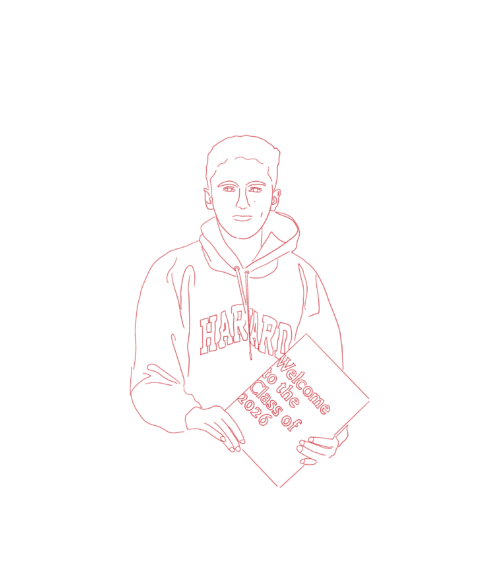
Trading Senior Class Committee events and final exams for a different kind of cumulative project, the 2026 English Undergraduate Oration Speaker has had a distinct senior week experience from their peers.
Noah Eckstein ’26 will deliver one of three orations by memory on Thursday, May 28, 2026, during the College’s 375th commencement exercises, along with a fellow undergraduate and a graduate student, all of whom were selected by a panel of judges. Commencement will welcome over 30,000 attendees, including degree candidates, faculty, parents, alumni, and the governing boards.
Each year, the ceremony’s first oration is given in Latin by a graduating senior of the College, the second is also delivered in English by a graduating senior of the College, and the final oration is given by a degree candidate from the University’s graduate or professional schools.
To enter the competition from which speakers are selected, College seniors were asked to prepare a draft of an English Oration for submission by March 27, 2026. In an interview with the “Harvard Independent,” Eckstein explained that the competition, in addition to requiring the writing of a complete draft, asks selected students to audition before finalists are ultimately chosen.
The College recognizes the selection of the three orators as one of the “highest honors a student can achieve” during their Harvard experience.
“[When] I got the email, I remember waking up, turning on my phone, just reading it. Like, oh, wow,” he recalled. The immediate excitement and surprise he felt upon receiving the news of his selection was quickly compounded by the gravity of the honor. “There’s a difference between thinking about [having to give a speech to 30,000 people] and actually realizing that you have to do it,” Eckstein said.
As part of one of Harvard’s oldest traditions, the Commencement orations, initially called “parts,” were used by students to defend their theses. However, throughout the College’s history, the topics of the orations have diversified to encompass themes related to both Harvard and its global community.
Eckstein’s speech expands upon a prominent conversation on and off Harvard’s campus: the necessity of open dialogue in an increasingly divided world. “Discourse seems to be a little bit on a decline, and just not even here, but in the wider world, as everything kind of gets so noisy now these days. Everything’s so loud,” he explained.
Eckstein contextualized the oration’s theme as a product of the graduating class of 2026’s unique Harvard experience. “Our class has really sort of borne the brunt of [everything],” he expressed. As freshmen in the fall of 2022, 2026 graduating seniors at the College were among the first students to fully participate in campus life and academics after the pandemic.
Eckstein also noted the enduring cultural and political spectacle at the University—from Claudine Gay’s resignation to the Department of Justice’s ongoing antisemitism lawsuit against Harvard—and the subsequent changes, arguments, and debates his class has experienced.
“There’s been a lot of political conflict with the world, just a lot of ideological conflict in the world, and that has certainly expressed itself on our campus,” he said. “[Through] all this stress, people find different ways of coping … [which] causes division, and so people talk about things, [have] disagreements, [form] defenses, [and express] opinions.”
Sharing how his initial writing felt less like a submission to a competition and more like something he had to get off his chest, Eckstein was driven by the fact that his unique religious background, having been exposed to all three major Abrahamic religions, allows him to talk about civic discourse in an honest, vulnerable, human way. “I really wanted to ground the idea of ‘we should talk more’ in the story of my own family and my experiences, growing up around that culture.”
Over the course of his four years in Cambridge, Eckstein has pursued dual enrollment between the College, where he studies Physics, and Berklee College of Music, where he studies Scoring for Film, TV, and Video Games. Eckstein is also concurrently pursuing his Master’s in Theoretical Physics at the University. The two fields of interest, while seemingly opposite, are meaningfully related to Eckstein. “These are kind of the two sides of my life that balance each other a lot … Keep me sane.”
While May 28 will technically be Eckstein’s first time delivering a speech to a large audience, he is no stranger to the stage, having played guitar for most of his life. “I’ve been performing since I was eight years old, but that’s a little bit different,” he explained. Instead, memorizing the speech has proven more intimidating for Eckstein. “I’ve learned to deal with the stage fright. I’ve done shows. I’ve been in front of a couple thousand people before. 30,000 [or] 10s of thousands [are] definitely a different magnitude.”
As commencement approaches, Eckstein has received a wide range of support from the College, including suggested revisions to his submission, rehearsal opportunities, and speech coaching, for which he expressed particular appreciation.
“From [selection] on, everybody in the committee was [involved], some are professors, some are administrators, some the committee,” he said. “Everything in the speech is still very much up to me. I have the final say.”
While his speech participates in a national conversation about the importance of dialogue and viewpoint diversity, Eckstein believes it embraces the power, not the faults, of differing opinions and perspectives. “We need to be using [our] specific diversity to address problems, and … to find a path forward.” And beyond that, he believes that his words embody Harvard’s promise of a transformative undergraduate experience through both academic and social-emotional learning.
“Through all of the ups and downs and all of the insanity of being at a place like Harvard, I wouldn’t miss it for the world.”
Rania Jones ’27 (rjones@college.harvard.edu) is the Editor-in-Chief of the “Harvard Independent.”