Harvard’s Arnold Arboretum Continues to Prevent Redevelopment of Poor Clare Nuns’ Monastery
Graphic by Neshama Ryman

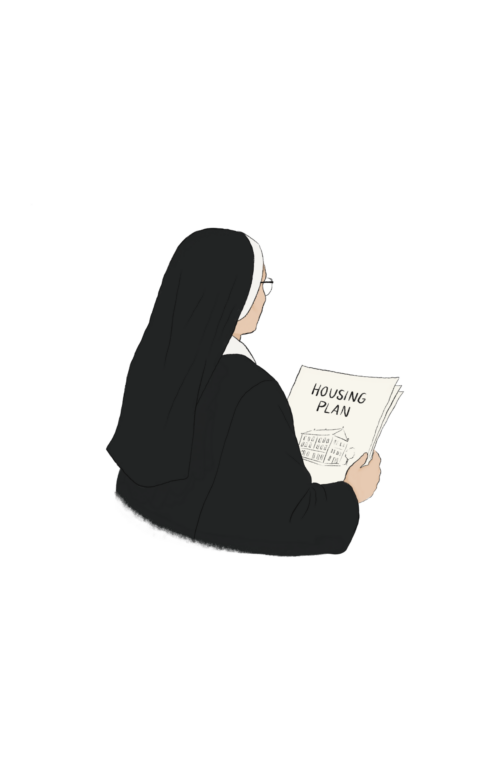
The Franciscan Poor Clare Nuns of Boston have been attempting to redevelop their old monastery in Jamaica Plain, Massachusetts, into housing since 2023. Harvard’s Arnold Arboretum, the nature preserve next door, has consistently blocked these plans due to concerns about which buildings and residents would occupy the site.
On April 13, the nuns sent a letter to University President Alan Garber, hoping to resolve the issue. The sale of the redeveloped property will provide the nuns with funds to renovate their new home, and the project will provide much-needed housing in an area just outside Boston’s city center.
The Franciscan Monastery of St. Clare at 920 Centre Street in Jamaica Plain was home to the Poor Clare Nuns since 1934. They recently moved to a new location at 590 Gay Street, Westwood. In December of 2023, the nuns moved out because the space was too large for their number of residents, Sister Veronica told the “Harvard Independent.” The Abbess, Sister Veronica, runs the monastery’s business and takes care of the sisters’ needs. “It is a very stately, majestic building built specifically to be a monastery, and unfortunately, it was built to house 50 sisters, and we had dwindled down to 10,” Veronica explained.
Once the religious group decided to leave, they began considering what to do with the property at 920 Centre Street. Selling the property would generate money that the nuns could use to renovate their new location. First, they approached the Arnold Arboretum about purchasing the property, which is located next to the monastery’s property and has been there since 1872. The Arboretum is a preserve that houses a large collection of trees and plant species for research and documentation, and is free and open to the public every day. “At the time, they did not want to buy it,” she said.
Instead, the nuns found a developer, John Holland of Sixteen Penny, a design and construction firm, who would turn part of the property into condominiums and the other part into low-income housing for seniors. “He developed a very nice plan using a lot of ecologically friendly materials and also providing about 20% of affordable housing primarily aimed at seniors, which is greatly needed in the area,” Veronica said.
However, as the developer sought permits to build in Boston, the Director of the Arboretum, William “Ned” Friedman, objected to the plan. “He thought it would be detrimental to the trees,” Veronica continued. Holland elaborated, explaining that Friedman was concerned about the Arboretum’s viewsheds. A viewshed is the visible area of land from a specific vantage point—in this case, the Arboretum—and refers to how the development would affect what visitors can see from the preserve.
“We tried to satisfy those concerns. We did drone surveys where we surveyed every tree on the existing arboretum and trees that are on 920 Centre Street, and we actually demonstrated to the Arboretum that there are no visual impacts from the Arboretum looking up, because the trees completely screen it,” Holland told the “Harvard Independent.”
Still, according to Holland, the Arboretum was unsatisfied. They continued to stress that the trees around the Arboretum weren’t sufficient to screen the development, meaning that they couldn’t entirely block the view of the development from the Arboretum, considering that trees are temporary and buildings are permanent. The Arnold Arboretum did not respond for comment by the time of publication.
With the nuns’ goals in mind, Holland continued to adjust his construction plans several times to resolve the Arboretum’s concerns. Originally, they planned to preserve the monastery’s exterior while converting the interior into senior housing apartments. Still, due to the Arboretum’s requests, they now plan to demolish the building and develop new condominiums completely. Their most recent iteration, a U-shaped building that maintains 50-foot setbacks on the rear and front, is still in the works and addresses most of the Arboretum’s concerns.
The monastery and the Arboretum have long had a good relationship. “We always had a friendly relationship with them. If we had problems with a tree, they would come look at a tree,” Veronica said. “We would let people park in our parking area for Lilac Sunday and in the summer, because the parking in that area of Jamaica Plain is kind of limited.” Recent deliberations have put a damper on these previously smooth engagements.
Veronica and Holland, however, emphasized that the Arboretum is not the only arbiter in this development: the plans have also gone through Boston’s city planning process. “I think we’re entering our fourth year right now, but generally it doesn’t take this long to get through the process,” Holland said. “I would expect 12 months for a project like the monastery.”
Other housing development projects in the Jamaica Plain and Roslindale neighborhoods have faced similar issues. At 18-22 Arboretum Road, the Arboretum, alongside other conservation groups in the area, was hesitant to support plans to replace an industrial building with multifamily housing.
The Arboretum also had comments for a project at 3841 Washington Street. “I know that there were several comments raised similar to mine that if the project was allowed to move forward that it would have viewshed impacts and it would have use impacts on the Arboretum itself,” Holland said.
In public feedback on the project, Arboretum Chief of Staff Todd Washburn spoke about the likely increase in the number of visitors the Arboretum will host. Because 3841 Washington Street lacked its own public spaces, Washburn predicted that once the residents moved in, there would be an influx of visitors to the Arboretum. “We welcome new neighbors and are glad to have new visitors to the Arboretum. But the impact will be real and will add new demands to our operations.”
Meanwhile, Holland noted silence on a different initiative led by Hebrew SeniorLife. “There’s a project at 1200 Centre Street, which was a six-story building, which had a lot more shadows and viewsheds from the Arboretum, certainly more than what 920 did. That project got no comment from the Arboretum,” Holland added. “The Hebrew SeniorLife building is a Harvard-affiliated complex.” The project, now complete, resulted in Hebrew SeniorLife building a 78-unit affordable senior housing community.
Recently, the Poor Clare nuns sent a letter to President Garber about the issue. In the letter, they noted discrepancies, including those related to Hebrew SeniorLife’s project. “What I said to him is that we were looking to sell this property, so that we can finance an addition to the monastery where we live now,” Veronica explained. “And that would [Garber] please advise [Friedman] to be more cooperative with us.”
In their letter to Garber, the nuns noted that while Friedman said this new project would have adverse effects on the Arboretum, they had lived in the space for 89 years with minimal impact on their neighbors.
They also noted that Friedman lives nearby on Moss Hill, around 15 minutes from 920 Centre Street. “We find it difficult to reconcile this rhetoric with motivations that appear to be driven by personal interest. Dr. Friedman lives on Moss Hill and has explicitly stated in a Boston Bulletin article that our project would set a “precedent for Hellenic Hill, on Moss Hill where I live.” It is unacceptable for a Harvard official to use the University’s influence to engage in NIMBY activity that protects a personal neighborhood view at the expense of much-needed housing,” the Poor Clare nuns wrote.
Garber responded. “His response was simply that he would look into the matter, and he had directed the appropriate people on his staff to do that,” Veronica said. There was little further communication.
Currently, Holland plans to meet with Friedman on May 27 to address the Arboretum’s current concerns about the height and massing of the structure. “Ned [Friedman] has said that his final concern is height and viewsheds, but neither of those can be seen from the Arboretum,” Holland added.
In an email exchange between Holland and Friedman shared with the “Harvard Independent,” Friedman expressed a willingness to cooperate with the monastery’s development. “I genuinely believe there are opportunities to create housing on this site in a way that preserves the integrity of the Arboretum, as the Conservation Protection Subdistrict was designed to do,” he said. “My hope is that we can explore a design solution that works for both your team and ours.”
A resident of the area and member of the Longfellow Area Neighborhood Association, Nate Stell, added his thoughts. Longfellow Area is within Roslindale, the neighborhood next to Jamaica Plain. “Where I’ve been landing more recently is that I don’t actually think the Arboretum leadership is the core problem here. I don’t agree with Ned’s position, but I don’t begrudge him advocating for what he sees as the Arboretum’s interests,” he explained. “To the extent he is standing in the way of new housing around the Arboretum’s perimeter, it’s because the City is allowing him to do so. It’s the City’s prerogative to allow a project to proceed or die on the vine.”
The project recently passed another step with the city. “The chief planning officer, whose name is Kairo Shen, for Mayor Wu, gave the developer permission to go through the commissions to get permission to build his project, and hopefully he will be able to finish that process by the end of the summer,” Veronica added.
“The most updated project is being socialized in the neighborhood right now. We’re doing what I call the kitchen table tour. We have a scheduled public meeting on June 28 with the Jamaica Hills Association,” Holland said.
While the project is not yet complete, the nuns look forward to using the funds from the sale to improve their new monastery and support sisters in other monasteries. Many community members in Jamaica Plain are excited about the new housing it will provide.
Elle du Pont ’29 (edupont@college.harvard.edu) writes News for the “Harvard Independent.”