Congressman James Clyburn on Party Identity, Public Trust, and Lessons From the Past
Graphic by el richards

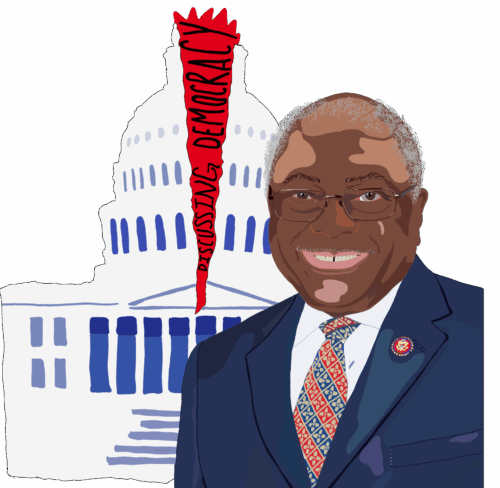
In an era marked by political polarization and institutional distrust, many Americans are questioning the role of morals in public leadership. This reality took center stage during an April 14 discussion at the Harvard Institute of Politics JFK Forum, where Congressman James Enos Clyburn joined moderator Anthony Foxx to explore the importance of moral leadership in today’s tumultuous political landscape. Drawing on his personal background and legislative experience, Clyburn discussed the guiding principles behind his public service, how those principles have shifted over time, and the Democratic Party’s role in that evolution.
Clyburn, now serving his 16th term as the representative for South Carolina’s Sixth Congressional District, is among the most senior members of the U.S. House of Representatives. Since his election to the chamber in 1992, Clyburn has held various leadership roles, including multiple terms as House Majority Whip and as Assistant Democratic Leader, from which positions he helped advance major legislation such as the Affordable Care Act (2010), the American Rescue Plan (2021), and the Infrastructure Investment and Jobs Act (2021).
Foxx is the director of the Center for Public Leadership and the Emma Bloomberg Professor of the Practice of Public Leadership at the Harvard Kennedy School. Previously, he has served as Secretary of Transportation under President Obama and as mayor of Charlotte, N.C.
For Clyburn, moral leadership is not a one-size-fits-all concept. “I know what I think is required of me,” he said, reflecting on how expectations of right and wrong vary across time, communities, and personal experience. “We struggle with that which is moral.” He emphasized that moral frameworks are not fixed; they shift based on historical moments and cultural context.
Reflecting on his background, Clyburn shared how his upbringing and his father shaped his moral compass.
“My father was a fundamentalist minister,” he said. “I shall never forget my sophomore year at South Carolina State…[when] I went home to tell my dad that I was not going to go to the seminary as we had planned.”
“He said to me on that day, ‘Well, son, I suspect the world would much better see a sermon than to hear one.’” For Clyburn, this moment underscored the belief that moral leadership is not about preaching ideals but embodying them through action.
From here, Clyburn linked his familial roots to his fundamentalist Christian church upbringing—both continue to influence his conception of morality.
“My favorite Bible verse is Micah 6:8,” he said. “‘For He has shown you, oh man, that which is required. Do justly, love mercy, and be humble. To me, that is my moral compass. To do that which is just. To be merciful and to be humble.”
While he expressed uncertainty about the direction morality may take in the political and social sphere, Clyburn offered a glimpse into his current framework for leadership and the forces likely to influence it.
“I look upon morality like the Supreme Court justice who once said of our constitution, that it
is a living document that makes adjustments, and makes changes, based upon the times within which we live,” Clyburn said. “I have no idea what the moral underpinnings of this country will be next year this time…I do believe very strongly that what happens in this country over the next year will pretty much tell us what the morality will be going forward.”
After former President Joe Biden withdrew from the presidential race on July 21, 2024, President Donald Trump proceeded to win the November election, prompting ongoing debates about whether the Democratic Party’s loss could be attributed to the late timing of the candidate switch.
However, regardless of the reasons for the 2024 American presidential election outcome, Clyburn reflected on Biden’s leadership, emphasizing the often-overlooked distinction between style and substance in modern politics.
“We are in an era when substance takes a backseat to style,” he said, arguing that Biden’s accomplishments have been overshadowed by public expectations for a more charismatic presence.
“Mr. President, the big problem that you have is that the style people are looking for—you’re never going to be able to give it to them,” Clyburn recalled telling Biden directly.
Clyburn defended Biden’s record, placing him among the most substantive presidents in recent history. He cited the American Rescue Plan, the Bipartisan Infrastructure bill, the CHIPS and Science Act, and the PACT Act as landmark achievements that reflect Biden’s commitment to meaningful change while in office.
“On substance, nobody since Lyndon Johnson has been more substantive than Joe Biden,” Clyburn said. “You can look at any metric that you may want to use, and you won’t surpass it.”
Against the backdrop of historical insight came a sobering examination of today’s political climate—one marked by federal threats to defund long-standing institutions, deepening polarization, and a growing sense of disillusionment. As these pressures mount, questions about the strength of democratic institutions have taken center stage. In response to these concerns, Foxx asked Clyburn whether he remains optimistic about the future.
“I’m hopeful and I’m a pretty optimistic person,” Clyburn said. “But I’m fearful—I just have to admit that. Hopeful, but fearful.”
For him, history is not merely a record of the past but also a guide for the present and a warning for the future. In his view, the country is ignoring history’s most vital lessons.
“We are, relatively speaking, a young nation,” he said. “There have been strong nations before us…and I think that history ought to be instructive. You have to learn from history—you can’t just deny it, you can’t misrepresent it, because the facts are the facts.”
His concern lies in the possibility that the U.S. is repeating familiar mistakes. “If we fail to learn the lessons of history, we’re bound to repeat them,” he said.
The warning comes amid growing concerns from leading scholars about the democratic threats posed by recent government actions. This past week, a “Los Angeles Times” article featured Harvard political scientist and “How Democracies Die” co-author Steven Levitsky, who has warned that “we are currently witnessing the collapse of our democracy.” Levitsky, who has spent decades studying authoritarian regimes, helped organize a letter—signed by over 800 faculty members—urging Harvard to defend academic freedom and resist what he and others view as a coordinated attack on higher education by the Trump administration.
Clyburn’s attention shifted to the Democratic Party and its standing with the American public. Since the 2020 election, many voters—especially younger and working-class Americans—have voiced frustration with the party, convinced it has fallen short in delivering on its promises. Foxx raised the issue, asking whether the Democratic Party is facing a messaging crisis.
For Clyburn, however, the problem is not messaging.
“Just because you failed to win an election doesn’t mean that you were wrong for the country,” he said. “If you just go legislatively, the CARES Act, you go right through it, the country is with the Party on all those things. So then what’s the problem? Everybody says, ‘Well, the problem is the message.’ No, it’s not the message.”
Instead, Clyburn said, the Democratic Party is facing a branding crisis—one largely imposed from the outside. “I’ll admit the Party is suffering from branding,” he said. “And the question is: did we brand it ourselves, or have we been branded? The Party has been branded.”
While some blame internal leadership roles or strategic failures, Clyburn pointed to the role of the media and the political maneuvering of the Republican Party. “The media brands us according to the articulations of the Republicans…which is an insult to the Democratic Party.”
He went further, contrasting the tone and tactics of the two major parties. For him, the Republican Party’s messaging has been more effective not because it’s clearer but because it plays on hostile emotions.
“The Democratic Party does not sell well,” he said. “Hate sells. People are going with what sells.”
In reflecting on the current political and media climate, Clyburn returned to a subject he has long emphasized: history. When Foxx asked about recent efforts to defund or reconfigure institutions like the Smithsonian, the Kennedy Center, and the National Museum of African American History and Culture, Clyburn was direct.
“It’s about whitewashing history,” he said. “That’s all that is.”
He argued that these actions represent a broader effort to erase historical truths, particularly those tied to race and Reconstruction. He spoke of the significance of acknowledging the contributions of African Americans, including the 17 Black congressmen who served during Reconstruction and the critical role of the Black church in political life.
“What we’re seeing now isn’t new,” he said. “It’s part of a long pattern in American history.”
“You cannot become a good Democratic nominee by being Republican-lite,” he added. “You’ve got to go all in and be who you are.”
Clyburn cited Biden’s 2020 campaign as an example. “Biden won the presidency by being Joe Biden,” he said. “That infrastructure bill? It was part of his campaign. People flocked to him, and they won. And of course, the branding took place, and they spent all their time making him a pariah.”
Still, he argued, moral leadership is not about public approval. It’s about standing firm in the face of it. For Clyburn, this ultimately means defending uncomfortable truths, uplifting underserved communities, and preserving the lessons of the past.
Nashla Turcios ’28 (nashlaturcios@college.harvard.edu) writes News for the Harvard Independent.