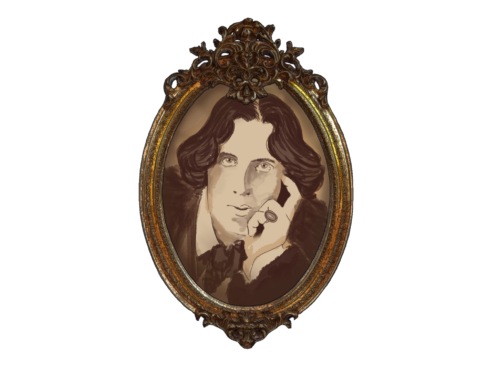
Serving Face and Serving Time: The Trials of Oscar Wilde
Graphic by Emma Crago

It is difficult to discern whether Oscar Wilde is better known for his literary works or for his homosexuality; the two were often intertwined. As queer historian Kaz Rowe put it in their YouTube video essay titled “The Unhinged Trials of Oscar Wilde,” which inspired this article, Wilde is the “premier homosexual.” His likeness lives on in 21st-century culture—the effeminate, crop-top-wearing, theater-loving stereotype we know today is a direct descendant of Wilde.
The most famous photographs of Wilde depict him lounging in lavish furs and clothes. The Oscar Wilde Memorial Sculpture in Dublin, Ireland, depicts him reclining on a rock with one knee propped up, smirking at park passersby. Through a modern lens, any viewer will immediately recognize his style of dress and posture as “gay-presenting.” But it is important to remember that Oscar Wilde does not merely match the social cues we associate with a gay man; he is the definition of how a stereotypically gay man looks and behaves.
For most of human history, “homosexuality” was something one did, not an identity label. There was no way to identify a gay man based on stereotypes or collective imagination. However, this would change with the infamous, highly publicized trials of Oscar Wilde.
The story begins in 1891, when Wilde met Lord Alfred Douglas, better known by his nickname “Bosie.” They were both involved in literary circles and soon began a tumultuous, on-and-off relationship. In 1895, Bosie’s father, the Marquess of Queensberry, discovered that their relationship was more than platonic and sent Wilde a note calling him a “posing sodomite.”
Instead of ignoring the blackmail, Wilde sued Queensberry for libel. This doomed Wilde from the start, as a libel case requires the spread of false information—and the note had not even been made public, nor was Wilde particularly careful about covering up his relationship history. Queensberry was able to acquire an overwhelming amount of evidence proving that his accusation against Wilde was true.
Interestingly, Wilde himself was not particularly interested in defending himself against the accusations of sodomy. While being cross-examined by Queensberry’s attorney, he seemed to prioritize coming up with the funniest witticisms. Wilde ended up condemning himself, as many of his responses insinuated that he was homosexual.
The cross-examination on April 3, 1895, began with Oscar Wilde lying about his age for laughs, immediately stripping him of what remained of his credibility. Edward Carson, Queensberry’s lawyer, questioned Wilde about his age, as he stated he was 39, though he was almost 41 at the time. Wilde responded, “I have no wish to pose as being young. I am thirty-nine or forty.”
Then, unprompted, Wilde brought up Bosie’s exceedingly beautiful poems, “In Praise of Shame,” and “Two Loves.” The latter contains the famous line, “I am the love that dare not speak its name,” an obvious metaphor for forbidden love. Carson asked if the poem was about “two boys,” to which Wilde agreed, creating suspicion about the true nature of his relationship with Bosie.
Carson continued to question Wilde about depictions of homosexuality in his writings, becoming increasingly frustrated by Wilde’s paradoxical and confusing responses. He cited a passage from “The Picture of Dorian Gray,” a novel widely understood to contain homoerotic undertones. In particular, he questioned Wilde on a line spoken by the character Basil Hallward, a painter infatuated with Dorian Gray, which reads: “I quite admit that I adored you madly, extravagantly, absurdly.”
“What do you say to that? Have you ever adored a young man madly?” Carson asked.
“No, not madly; I prefer love that is a higher form,” Wilde replied.
“Never mind about that. Let us keep down to the level we are at now?” Carson questioned.
“I have never given adoration to anybody except myself,” Wilde remarked. The transcript notes that the courtroom laughed loudly after this witty line.
Wilde maintained this sassy, evasive demeanor for the rest of the interrogation. When Carson brought out letters from Wilde to Bosie as evidence, his only defense was to claim that the letters were “poems” and could not be taken at face value.
After Wilde blatantly admitted that he had “always been fond” of Bosie, Carson seemingly got confused about which side he was supposed to defend. He suggested that some parts of the poems could be read in a non-romantic way, depending on how literally it was interpreted.
But Wilde responded, “A great deal depends on the way it is read … Not as you read it, Mr. Carson. You read it very badly.”
In a separate interrogation the following day, Wilde dug himself into an even bigger hole. Carson questioned him on his alleged romantic and sexual relationships with other men.
“Did you ever kiss him?” Carson asked about Walter Grainger, a young boy.
“Oh, dear no. He was a peculiarly plain boy. He was, unfortunately, extremely ugly. I pitied him for it,” Wilde replied.
Many other similar, forehead-slapping instances exist in the transcript. Though these seem like reckless moments completely devoid of self-preservation, some interpret Wilde’s behavior as a refusal to feel ashamed of his homosexuality. Either way, at the advice of his lawyers, Wilde dropped the case that he started. However, he was arrested around a month later under charges of gross indecency and sodomy. In the case that followed, Wilde was sentenced to two years of hard labor, which led to health problems that made him vulnerable to the meningitis that ultimately killed him.
The media attention that the trials received solidified the image of a gay man in the public consciousness. His personality—foppish, artistic, feminine, witty—was easy to caricaturize and reproduce as a symbol of homosexuality. It also sparked the movement for other queer people to openly push back against homophobia. Wilde became a martyr-like figure for gay communities, transforming homosexuality into an identity for which one could express pride.
The modern stereotype of gay men resulted from the coincidence that Oscar Wilde had his particular personality—and was gay, a writer, and part of the larger aestheticism movement of the late 19th century. Had he not had any one of these attributes, our idea of a gay man would be drastically different. Mitch and Cam, the gay couple from the television series “Modern Family,” would be completely different characters.
Once Wilde’s personality entered the public consciousness, gay men began adopting his traits as a signal to others like them, and the archetype was born. After decades of increased LGBTQ+ visibility in public life, as well as popular media reinforcing the image, Oscar Wilde’s unique personality gradually became a reductive stereotype. What was once an expression of individuality came to harm the gay community. The markers of homosexuality became known to homophobes, enabling them to easily identify and generalize about gay men.
Today, many of our slang words come from the LGBTQ+ community and are often associated with being flamboyant and effeminate—two trademarks of Wilde’s character. What began as an unthinkably countercultural move—outing himself as a homosexual to the entire world—is now mainstream. The tragically hilarious trials of Oscar Wilde demonstrate the domino effect of history and how much one man influenced how we view an entire demographic today. History often seems coincidental, the unlikely intersection of a person at a specific time and place, yet it has the power to define how we perceive reality.
Ellie Guo ’29 (eguo@college.harvard.edu) thinks about Oscar Wilde every time someone says “slay.”