
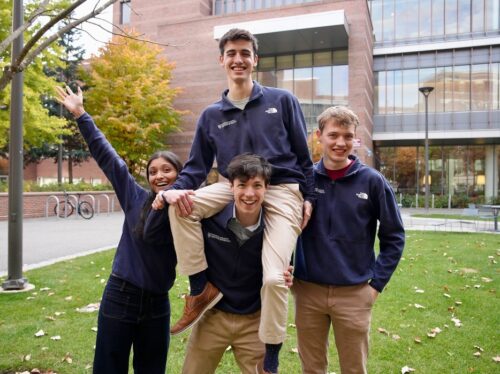
On Monday, Nov. 10, the Institute of Politics announced its 2026 Executive Board: Lorenzo Ruiz ’27 will serve as President, Will Smialek ’27 as Vice President, Jack Tueting ’27 as Treasurer, and Dhara Patel ’27 as Communications Director. Arriving in these new roles amidst IOP Director Setti Warren’s unexpected passing and a tumultuous political year, the team bears both the responsibility and privilege of continuing Harvard’s strong bipartisan legacy.
“If the last decade of American political leadership has taught us anything, it’s that engagement is the most important check on autocracy and the decline of democracy,” Ruiz said in a group Harvard Independent interview with the new executive board. “If the IOP is a testament to anything, it is to engagement and involvement and bringing in other people.”
Four Lifetimes of Political Involvement
Ruiz, Smialek, Tueting, and Patel all arrive on the Executive Board following strong careers in politics and at the IOP.
Born and raised in Ohio, Smialek’s roots in education policy defined his middle and high school years. How to govern schools in the midst of the pandemic, coupled with rising discussions in 2020 about the teaching of critical race theory drew Smialek to school board meetings and discussions on mental health. “There was this really big disconnect between what administrators were talking about and what our community members were talking about, what students were actually feeling on the ground level,” he said.
“It got me really interested in ensuring that all students—all people—have a voice on the decisions and the policies that impact their lives.”
Upon arriving in Cambridge, Smialek learned of Fellows and Study Groups and immediately took interest. He began as a liaison for visiting fellows before advancing to leadership roles, including IOP Director of Membership and FSG co-chair. Smialek said he’s eager not only to further his personal passion for the government but also to see the roles he’s leaving thrive under new undergraduate guidance.
Similarly interested in education and health policy, Patel has explored a range of programs across the IOP, seeking different ways to apply her professional and personal curiosities. The Policy Program, with its research format and diverse topics, spoke to Patel early on. From there, Patel joined the Harvard Political Review and later rooted her IOP career in FSG and the Student Advisory Committee. “I think the IOP has been a true hallmark of my experience at Harvard,” Patel said.
Tueting was familiar with Harvard’s IOP before even stepping foot on campus. “When I was choosing which school to go to, I think the IOP really stood out just for the wealth of opportunities that they had to promote public service among students. That was something I was super, super passionate about,” Tueting explained.
Growing up on a farm with a mom who worked multiple jobs to support his family, Tueting became interested in the strengths and flaws of American governance from an early age. “I wanted to make change,” he said.
Campaigns and community organizing defined his secondary education—it felt only natural to bring those interests to Harvard.
Since his freshman year, Tueting has immersed himself in a range of political spaces on campus. Currently chair of the Harvard Political Union, he also serves as Director of Research for the IOP’s Harvard Public Opinion Project and co-president of the Harvard Democrats.
Though sustaining an impressive three years at the IOP, Ruiz admitted he wasn’t ready to dive in immediately upon arriving at Harvard. “I remember the first impression of the IOP I got was just generally intimidated,” Ruiz shared. “I was pretty aloof my freshman fall.”
After witnessing peers thrive in what had seemed like an impenetrable organization, Ruiz realized the IOP could help him develop professionally alongside like-minded undergraduates. “The IOP became my life,” Ruiz said. “It is a labor of love.”
Ruiz first joined the Campaigns and Advocacy Program before branching out to other initiatives. This past year, he was elected to serve on the IOP Executive Board as Communications Director—a role Patel will now assume.
A Youth Executive Branch
Despite their deep involvement with the IOP, all four undergraduates said their decision to serve on the Executive Board was shaped by distinct experiences within the organization.
Keeping with his early enthusiasm for the IOP, Tueting’s choice to lead the Institute next year centered on access and opportunity—motivated by his trip to Detroit with the HPOP ahead of the 2024 presidential election his freshman year. “That was a super life changing experience—getting to see on-the-ground how politics and campaigns work, how messaging really resonates with voters.”
From there, Tueting realized that an organization with 18 distinct programs and over 1,000 involved students extended far beyond the walls of the Harvard Kennedy School. The breadth of opportunity and strong campus connection made his decision to join the Executive Board feel inevitable.
“It was the entire summer of 2024, right before the election,” Ruiz echoed, recalling both the anticipation in the air and his experience at the Democratic National Convention.
Now entering his second term on the IOP’s executive team, Ruiz said he has embraced the values of public service both on Harvard’s campus and beyond.
“The IOP is a place where I can have an impact on students’ lives, not only while they’re at Harvard, but can help give the kinds of job opportunities, counsel, and support to move people in the direction of public service that will have an impact for decades to come,” Ruiz said. “And ultimately, that is the goal of every single person who takes on leadership here at the IOP.”
Bookending his start at the organization with his decision to lead it, Smialek recalled the IOP’s annual opening event at the Science Center Plaza. Speaking with hundreds of politically motivated freshmen reminded him of the same sense of purpose that first drew him to the IOP.
“Their eyes are wide open and have that glimmer of awe and excitement about the opportunities that this organization can present to them,” he recalled. “It was really encouraging to me.”
Like Smialek, Patel was drawn to the IOP initially and now to senior leadership by her passion for the student experience. In her current IOP position as Director of Special Projects, Patel saw firsthand how each of the Institute’s program operates. “I found it really unique that each different program had their own deliverable,” she said. “It is important to showcase the work that people do.”
As Communications Director, Patel hopes to highlight undergraduates through the IOP’s website, social media, and other burgeoning initiatives.
Elections Amidst Setti Warren’s Passing
With such robust backgrounds, these four entered IOP elections ready to campaign and prove their dedication to the Institute. But unlike past years, where countless of emails, campus events, and strong platforms defined the race, Ruiz, Smialek, Tueting, and Patel all discovered they were running unopposed.
“From that point onward, there couldn’t really be a campaign process,” Ruiz said.
This change in circumstance coincided with Warren’s untimely passing. Wanting to make space for grief and remembrance rather than campaigning, the election commission adjusted its process.
“Overall, our number one intention was ensuring that we weren’t overwhelming the student body,” election commission member Andrew Zonneveld ’26 said in a statement to the Independent.
Under normal circumstances, a new Executive Board election would prompt a candidate forum, week-long executive campaigning, and an IOP-wide vote, as outlined by the IOP constitution. However, the uncontested positions coupled with Warren’s passing changed this process.
“When the candidate declaration deadline passed and the executive candidates were running unopposed, we did not believe it was in our constitutional purview to recruit more candidates,” another election commission member Morgan Byers ’26 wrote to the Independent. “Additionally, we believed that promoting a campaign with the outcome decided would detract attention from mourning the loss of Setti within the IOP. Overall, integrity and sensitivity were foremost priorities.”
All four executive officers agreed with the commission’s choice, recognizing Warren’s profound impact on the IOP and its students. “He was so committed to public service and uplifting students’ opportunities here at the IOP,” Ruiz said. “His life’s work was public service.”
“Setti had a lot of amazing ideas that were still in motion,” Tueting added.
Looking Ahead
Though the new Executive Board has innumerable ideas for the IOP, all emphasized the importance of stability.
“We’re here to be a voice for all of our students across our programs and to work hand-in-hand with staff and provide that institutional memory and support during this difficult time for our community,” Smialek said.
Their first step, they said, will be to identify what the Institute already does well and reinforce those strengths, while also furthering Warren’s mission, especially those aiming at preserving ideological diversity at the IOP.
“Public service will always be the focus and the centerpoint of what we do here at the IOP,” Tueting added. “As the Treasurer, it’s going to be my focus to make sure that all of the students have the funding to do public service initiatives, that all of [the IOP’s] programs are set up to succeed.”
“I’m going to make every effort to ensure [our students’] work is being represented,” Patel said.
All four hope to keep the IOP not only a place for socialization and community but also an institute that makes a tangible difference—from meeting with incoming program chairs to developing new leadership that will further the organization’s core values. The Executive Board will be holding a town hall soon to hear feedback from all IOP members before their term begins.
“A major priority for us is going to be to approach the next few months and the next year with a very open mind,” Ruiz said.
“The IOP isn’t a place that begins and ends at Harvard. It is an experience that extends to places like D.C., New York, and to careers in public service well beyond Harvard’s gates.”
Sara Kumar ’27 (sjkumar@college.harvard.edu) is the News Editor of the Harvard Independent.