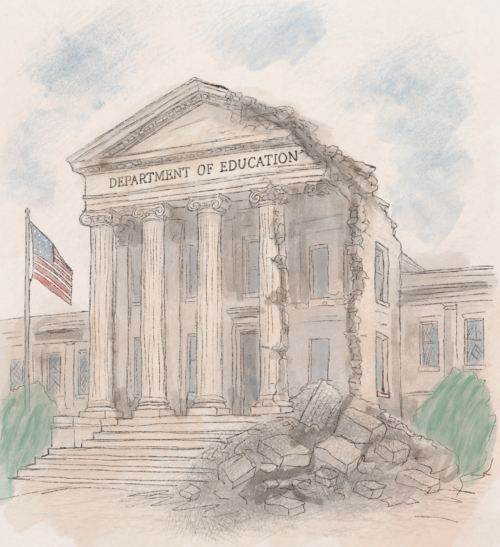
The Slow Dismantling of the Department of Education
Graphic by Trischelle Afihene

On April 22, Harvard Kennedy School Institute of Politics’ John F. Kennedy Jr. Forum hosted a conversation between Margaret Spellings, the U.S. Secretary of Education under President George W. Bush from 2005 to 2009, and John King ’96, the U.S. Secretary of Education from 2016 to 2017. The forum was moderated by Virginia Secretary of Education and current IOP Resident Fellow Aimee Rogstad Guidera. The three discussed the role of the Department of Education, the consequences of dismantling federal funding for higher education, and the Trump administration’s attacks on the greater importance of education in the United States.
The conversation opened with an explanation of the Department of Education’s origins. “The reason we have a federal role in the first place—which was part of ‘The Great Society’ in the LBJ Era—was that we had incredible variance around the country on achievement, and that, basically, your opportunity was absolutely determined by your zip code,” Spellings explained. President Lyndon B. Johnson’s War on Poverty initiatives focused on shrinking economic and racial disparities in the education system.
These initiatives continued to constitute only a small part of the overall budget for education, with each state holding majority say in schooling laws unless they impeded on civil rights. “How much the federal government gets done is actually a relatively small footprint,” King said. “The federal funding for education is less than 10% of the total.”
“Some of the rhetoric now to attack the Department is to say, ‘Well, we’ve gotta give the power back to the districts.’ Well, the districts have always had the power,” King continued. President Donald Trump ordered Secretary of Education Linda McMahon to take steps toward closing the Department entirely, starting with a proposal to convert federal education programs into block grants, which would allow states to distribute funds with fewer federal restrictions.
“One of the things I sometimes point out to folks to dramatize why we have the federal role [is] if you think about the famous Norman Rockwell painting of Ruby Bridges.” Rockwell’s “The Problem We All Live With” depicts the first African American child to attend the school after a federal court ordered the New Orleans school system to integrate in 1960. “Who’s around Ruby Bridges? U.S. marshals. Why U.S. marshals? Because New Orleans and Louisiana were not interested in protecting Ruby Bridges’ civil rights. They were not interested in making sure she got access to an equitable education. It took federal intervention,” King explained.
“What you see now, removing that federal role, is going to put students at risk. The bulk of the complaints that go to the office for civil rights are from parents of students with disabilities who are not getting the services they’re entitled to,” King continued. “To say, ‘Well, the districts and states will all do right by them,’ we know that’s not true. We have decades of evidence.”
Ignoring this evidence holds particular implications for U.S. education. “The other thing that we’ve lost is this sense—that President Bush and President Obama had—that education is a national imperative,” King claimed. “Now all the conversation is about how you move the boxes around between federal agencies.”
The Bush administration implemented the No Child Left Behind Act, aimed at decreasing the achievement gap through standardized testing. The Trump administration’s efforts to undermine the federal accountability requirements that remained under the Every Student Succeeds Act, a 2015 update to NCLB, have allowed for federal policy to be circumvented. “To my mind, ESSA was never really implemented as intended,” King said. “In the end, what you write down is only as good as the people who are executing on it. And there was not good-faith executing on ESSA.”
The rollback of NCLB and ESSA has proved detrimental to education nationwide. “It was the first—unprecedented in American history, for 20 years—to have student achievement across the board go up, gaps close, and we have just erased those 20 years of progress in 10 years,” Guidera said.
“There are two ways to think of this… either we should stop spending money and say ‘Good luck out there, let them eat cake, it’s not a national imperative.’ But if we’re gonna spend money, let’s get something for it in the name of this imperative,” Spellings added.
Guidera shifted the conversation to the Trump administration’s broader goal of closing the Department. “What is actually legally possible when we’re talking about dismantling the Department of Education? And what has happened to date, and what hasn’t happened?” Guidera asked.
“The Trump administration cannot unilaterally dismantle the Education Department. That requires Congress, and to my read, there is no appetite in Congress to dismantle the Education Department,” King said. “The Trump administration came into office … trying to cancel grants, asking Congress to stop funding federal research efforts … Fortunately, Congress rejected all of those proposals from the administration.” Federal funding increased from 2025 to 2026, with Congress proposing $79 billion in discretionary funding.
“So, what they’re doing instead is slowly sending functions to other agencies,” he said. “What they’re doing through the Memorandum of Understanding between agencies is trying to effectuate this vision of dismantling the Department. Mostly, what it’s doing is causing confusion and chaos.”
“[The Trump administration has] truly gutted… the role of federal research,” Spellings added.
The discussion turned to the administration’s threat to cut federal funding for higher education. “Pell Grants have made it possible for generations of Americans from low- and middle-income families to take advantage of higher education… [the] Trump administration proposed huge cuts to the Pell Grant Program. Fortunately, Congress ignored that,” King further noted.
In its Fiscal Year 2026 budget proposal, the Trump administration did indeed propose a nearly 23% cut to the maximum Pell Grant award, reducing it from $7,395 to $5,710. However, as of early 2026, Congress has largely rejected these cuts and maintained level funding for the program.
The administration has also indirectly affected the Free Application for Federal Student Aid. In April 2026, the administration launched a real-time fraud detection tool aimed at stopping “ghost students.” This tool, along with new identity verification requirements for all first-time applicants, is projected to save $1 billion through increasing processing hurdles for legitimate students.
King expressed deep concern not only for the added hurdles for receiving aid, but also for the lack of improvements he found necessary for the form. “The FAFSA is really important. It is the linchpin of our entire higher education financial aid system,” King said. “I’m very worried about the infrastructure of the Agency. Will it be able to continue amidst this slow dismantling?”
King, Spellings, and Guidera went on to discuss the larger impact the Trump administration would have on current students. “Pretty much since 2017, we have been without a real federal infrastructure around accountability,” King said. “All across the country, you have huge numbers of students who are not getting the foundation they will need just to be able to get a decent job in life,” King said. Indeed, 8th-grade math proficiency peaked in 2013 at 36%, but fell to just 28% by 2024. Average reading scores for 12th graders hit their lowest level in 2024 since national assessment began in 1992.
King emphasized the implications of educational decline for the U.S. economy: “Think about the importance of our higher education system, preparing a workforce that can compete with all the countries around the world that are also trying to prepare a successful workforce. We need that [the] voice of a Secretary of Education… be able to speak to these issues. We also don’t really have that at the moment.”
Courtney Hines ’28 (courtneyhines@college.harvard.edu) is the News Editor of the “Harvard Independent.”