Sarah Lewis Shapes Narratives
Graphic by Sage Willey

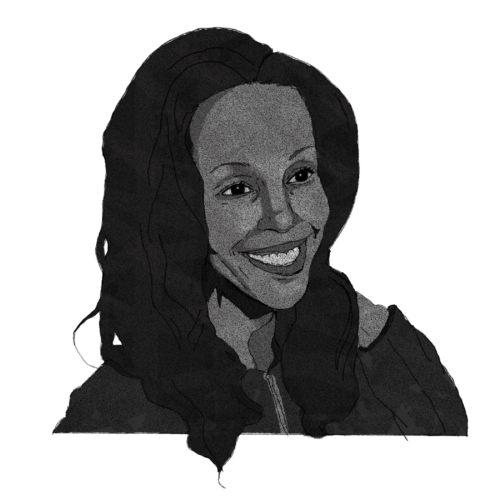
I met with Professor Sarah Lewis ’01 over Zoom, anxiously prepared to make the most of the 45 minutes I’d managed to secure in her busy schedule. Sitting in her History of Art and Architecture class, “Unseen Black Art,” last semester, always left me with a lasting impression of her attention to detail—evident in her diction, writing, and the analysis of art she taught us. Her gravitas carried through the screen, reflected in both her precise communication and her tidy background and crisp white blazer. It was impossible to ignore the sense of importance and urgency around the work she described and the need to contest traditional narratives.
Lewis’ scholarship, in magnitude alone, is impressive. She’s edited over 60 publications and authored multiple books—most notably “The Rise,” a bestseller translated into 7 languages; “The Unseen Truth,” which won the American Book Award; along with launching the “Vision & Justice Book Series,” one of the many publications produced by the initiative she founded of the same name. Earlier this year, she was named to the 2026 “TIME” List, The Closers, which recognizes key Black leaders, entrepreneurs, and activists working towards racial equality in America, and she has accepted a variety of distinguished awards for her work. She is, without a doubt, a Titan. And still, as I spoke to her, she remained humble about her accomplishments, emphasizing her ongoing mission to revise racial narratives and shift American culture forward.
I had wanted to speak with her so I could learn more about her clearly extensive efforts beyond Harvard’s curriculum—I also wanted to know if I could tangibly contribute, even as just a college student. Lewis explained everything to me with nuance and stayed grounded in literature. When I asked her how a non-art student could contribute to her mission of cultural contestation, her response reoriented the scope of my question, as though a fundamental truth had been revealed to me.
“The work I do isn’t solely about the arts at all. It is about the power of narrative for defining who we are, and increasingly, the narratives we receive—those we’re conditioned to understand—come to us through culture, through the image, through the monument, right through the object,” Lewis said. “The power of narrative through culture is a way to engage with the entire world, and the entire world engages with each other through the power of culture.”
Lewis’ upcoming exhibit, “If Emmett Till Lived: Freedom on American Ground,” set to debut at the Museum of Contemporary Photography at Columbia College Chicago, is just one such way she is engaging with the world on her own narrative terms. The approximately 200-piece collection will be on display Sept. 10 through Dec. 19. The timing of the exhibition feels especially relevant, given President Biden’s 2023 proclamation designating a national monument for Till, and the ongoing political debates over such monuments by the Grand Old Party. “The journey to honor Emmett Till really speaks to the force and power of erasure in society,” Lewis explained. “The exhibition aims to be yet another creative exponent of the monument building process to honor Till.”
She’s chosen, from a collection of around 20,000 objects, key items that represent chronologically a life that she said, “we all would have wanted [Emmett Till] to have been able to choose.” The urgency is implicit. We, as viewers, must confront the question Lewis poses for us, and the one she asked me. “What would have been required of all of us in society for Till to have lived?”
This examination of our past comes through the evocative lens of the photograph. This medium, in particular, has a long history in Black visual culture. Frederick Douglass and W.E.B. Du Bois famously leveraged the emerging technology of the photograph to advance notions of Black equality. Yet this exhibit isn’t just about bringing together key photos to speak to Black experience—it’s about the memorialization of Till and his story. “I believe that monuments are the closest thing that we have to a Truth and Reconciliation Commission in the United States,” Lewis told me. “Because of the narrative war we’re in, we need the object to ground us in the facts of our history.” Her exhibit will do just that.
In addition to her curated objects, Lewis has invited 27 individuals to each select an image they feel represents the life they’d have wanted Till to live. The individuals, whose names have yet to be released, include leaders, filmmakers, and civic figures from Mississippi to Chicago. “It will be, in effect, a collective honoring and a collective curatorial enterprise,” Lewis explained. This choice to bring a communal voice to her exhibit aligns with much of her work—she is no stranger to collaborating with other trailblazers and legends in the space.
In our short conversation, she mentioned dozens of colleagues, mentors, and even students with whom she’s formed deeply substantial relationships. “This work requires endurance, and to sustain that, you’ve got to find all the ways in which you’re going to just keep that humor, that positive spirit,” she asserted. For Lewis, friends like Sherrilyn Ifill, the Founding Director of the 14th Amendment Center for Law & Democracy at Howard Law School, help embody the values necessary to succeed in this space. “What I believe [Ifill] exemplifies is the need to maintain rigor, and joy together, always, at once,” she expressed.
Given Lewis’ many significant endeavors, I wondered how she managed to juggle them all at once. Lewis’ motto is clear: “The main thing is to keep the ‘main thing’ the main thing.” “There are no shortcuts to thought leadership of that kind,” Lewis elaborated. “When you’re committed to that main thing, you’re able to also galvanize an energy to you through the penetrating concentration and deep investigation of a topic.” Lewis has absolutely galvanized an energy and a movement. Her work has inspired others and drives forward an important narrative grounded in her own experience. Through her curations, her words, and her teachings, she’s writing a new and permanently important cultural story.
Mia Tavares ’27 (miatavares@college.harvard.edu) is President of the “Harvard Independent.”