To Be Seen
Graphic by Neshama Ryman

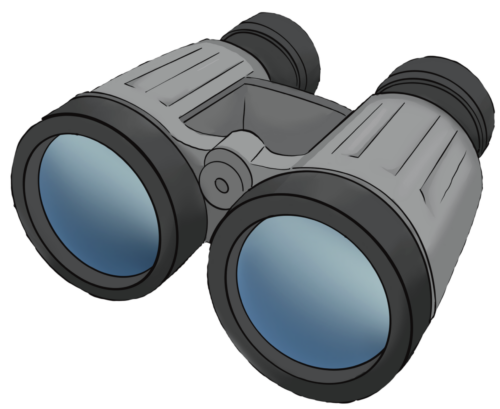
“It’s one thing to be looked at, and another to be seen.” These words come from Caleb Azumah Nelson’s “Open Water” and speak to a question I’ve found myself grappling with this semester. What does it mean to be seen?
I have a running bit with some of my close friends where, if we spot each other across a distance, we forgo waving and instead mime putting on binoculars—our shorthand for saying “I see you.” Why we started doing this, I don’t know, but from my understanding, it is more than a simple greeting. We could wave or even shout “Hello” across the Yard, but instead, we have chosen binoculars to be our symbol of acknowledgment.
Binoculars are an inherently curious piece of equipment; at their most basic level, they are necessary for seeing things the naked eye cannot. But in a way, their use also marks a commitment to seek out more than what we are offered at face value. So by whipping out our “binoculars,” we’re not only saying “Hi,” but also saying that I recognize that you are more than meets the eye.
Though the concept of being more than meets the eye is now something of a cliché, it speaks to a reality that many people struggle with daily. Oddly, when writing this, I was reminded of the 2011 movie “The Help.” In the film, Aibileen Clark, a Black housemaid, cradles the child she cares for, Mae Mobley, and says: “You is kind. You is smart. You is important.” I have found that these words go beyond foundational affirmations: they are a reminder to see other people beyond what they may appear to be. However, in order to see others in this way, one must first look inward and see oneself for who one is.
You are more than what society tells you you are, more than what your parents might diagnose you to be. You are a deeply complicated being. You are human and deserve to be seen. Seen not for what you were or could be, but for what you are in the moment that we find you. This works both ways; to be able to see other people most fully, we must first be able to see ourselves as we are.
There is a scene in the otherwise completely comedic, original “Zoolander” film where famed model extraordinaire Derek Zoolander catches a glimpse of his reflection in a roadside puddle and pauses. “Who am I?” he asks his reflection. “I don’t know,” his reflection responds. This moment of powerful introspection ends with Derek’s line, “I guess I have a lot to ponder.” We all need our Zoolander moment. The film’s humorous core returns when a car drives through the puddle, splashing Derek’s face. However, the question lingered in my mind for a long time. Who are you when no one is looking?
I alluded to this idea in my last article when discussing the “you that exists outside of Harvard,” the thought that, in order to live better, one must reject the pressures society typically exerts on you to force you down a predetermined path. My argument here is different. To know yourself requires rejecting performance orchestrated to appease others; it demands you bear the uncomfortable experience of staring yourself down in the mirror (or puddle) and being open and honest with what you see. If we are unable to do that for ourselves, how can we honestly, binoculars and all, truly see the people standing across the Yard from us?
It is easy to talk about the idea of performance as an abstract or even philosophical topic in writing, but it is much harder to reckon with how it manifests itself in the real world. I recently had a conversation with a friend where she asked me if I was pretending or being real with her. The answer was, “I don’t know.” I wanted to say I was always being real with her, but the longer I have thought about it, the less certain I am of what “real” even means in that moment. Was I being real if I was still adjusting my personality or reactions based on who I was speaking to? A question too large to answer within this article, but what stayed with me most wasn’t the question itself but the realization it left me with. Performance isn’t always deceptive or deliberate, but sometimes it’s just habitual.
Performing has always come naturally to me; perhaps that’s why I pursued it as a profession. It was easy to tell the right jokes or smile when I was supposed to because it made people happy. It was easy to do the things all my friends did because I didn’t want to be the odd one out. As I grew up, the line between what was performance and reality became blurred, and I feel like I lost a part of myself along the way. Then, the COVID-19 pandemic happened, and, for my journey of self-discovery, I’m glad it did.
For me, COVID-19 was the first time in a long time that the curtains closed and the performance had nowhere to go. I spent literally two years practically locked up at home with my family, with nothing more to do than to look in the proverbial mirror, coming to terms with who I was at the moment and who I wanted to be.
I’m returning to Aibileen—when she would tell Mae Mobley the basics like, “You is kind. You is smart. You is important.” Knowing what I know about myself now, the phrase feels incomplete. I would add one more qualification as a mantra to live by: “You is kind. You is smart. You is important. You is enough.” You are enough because you are you, and often people feel incomplete because they have spent so long performing that they’ve forgotten what being authentic looks like.
Performance is safe, I understand; playing the role of someone else always gives you somewhere to hide, but hiding isn’t an option. Pretence breeds unhappiness, and unhappiness breeds even worse outcomes. Take off the mask and let the crowd moan and jeer that their jester has danced their last jig. Be you. Be loud and proud of who you are, and don’t let someone yucking on your yum ruin your day. Your authentic self is enough, and just because they might not see that yet, it doesn’t mean it’s not true.
Noah Basden ’29 (nhbasden@college.harvard.edu)played far too many games of Scrabble during COVID.