When the Rain Stops Looking Like the Movies
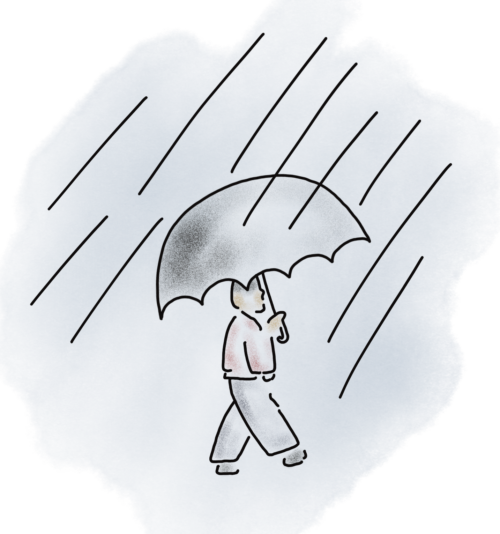
Graphic by Kerrie Zhu

On rainy days growing up, my family and I would cuddle up on the sofa under a pile of blankets, make a cozy cup of tea, and turn on our favorite comforting romantic comedies. By the time the credits rolled, the storm would have subsided, and my face would always be soaked with tears of both joy and sorrow. Call me sentimental or cheesy, but as a hopeless romantic, I always had a soft spot for these films. My favorites are those with classic downpour scenes in which one partner comes running after the other, confesses their love, and they passionately embrace, sharing a moment in the middle of a deluge.
One of these quintessential moments is from Nick Cassavetes’s “The Notebook,” which never fails to make me tear up. Noah, charmingly played by Ryan Gosling, stands soaked in dramatic, torrential rain, gazing at Rachel McAdams as the character Ally. The intensity of the weather matches the emotion in his heart, as Noah confesses, “It wasn’t over. It still isn’t over!” Something about it always opens my floodgates: the way I know the climactic moment won’t endure forever—the droplets will cease, and the two will have to confront the reality of their tumultuous relationship.
Greta Gerwig’s “Little Women” features another iconic rain scene, in which Jo March, played by Saoirse Ronan, is seen running frantically to the train station to stop Professor Friedrich from leaving. Although my friends would tell me I might be more of an Amy, I had always empathized with Jo, someone who stubbornly wanted to be strong and independent. Yet as she steps into the storm, Jo finds the courage to admit that it is okay not to have to do everything on her own—curls soaked and petticoats drenched, she realizes it is okay to want someone to weather the inevitably rainy days with. Jo ultimately ends up under Friedrich’s umbrella, telling him, “I don’t want you to leave, I want you to stay!”
The precipitous climax (pun intended) of “Breakfast at Tiffany’s” is another classic I find myself rewatching for comfort. As droplets cloud the window panes, Audrey Hepburn’s Holly Golightly silently cries to herself after losing her cat and being abandoned in a taxi by her love interest, Paul, played by George Peppard. Ankle-deep in puddles, she frantically searches for her beloved pet “Cat” and sees Paul looking as well. When the cat finally meows and resurfaces, with “Moon River” beginning to play, Holly and Paul share a kiss, wet cat and all.
In these films, weather becomes a form of communication, or perhaps even a kind of ironic intervention—there is something nostalgic about how notoriously “bad” weather symbolizes something different when you are in love. In these moments, storms make people want to impulsively declare their love, dance, sing, or become another version of themselves. And yet, people still say April is the longest and dreariest month because it has grey skies and cumulonimbus clouds.
With such romantic comedies serving as the backdrop of my childhood, my perception of rain differed from the conventional narrative: I grew in the puddles and found shelter in downpours.
And I would always return to my couch for a similar rotation of cinematic classics, with the same blanket I once laid under with my parents, whenever life became too overwhelming—the films offered a third space for me to go to if I was eventually tired of the physical and metaphorical rain, seeking to live vicariously through the idealistic lives of Hollywood characters. Whether it was a feel-good friends-to-lovers film or a painfully devastating one, something about returning to the comfort of my bed covers and the safety of the characters I felt like I’d known my whole life was easier than getting up and braving the weather.
It wasn’t until recently, after a particularly long day, that I recognized the habit I had developed. I had instinctively turned on Netflix and mindlessly rewatched another rom-com for the umpteenth time.
It wasn’t only my way of avoiding my problems when things were no longer sunny; it was also my way of rethinking them and redefining the ways I had grown up learning romance from romantic comedies. I had always thought love in real life was the way it was portrayed in the movies: passionate, sudden, urgent, and full of feeling. Yet after recently losing a romantic relationship, I was able to recognize all of the other relationships I had grown through and see all of the people who had stayed with me through my lowest.
Love isn’t the passionate kiss in the rain scene or the sudden outburst of emotion. It is about not disappearing when the weather takes a change for the worse, about showing up in quiet, unspoken ways. It is the way my roommates remember I don’t like cheese except for on pizza; the way my dad stays up late to make sure I’m home safe; the way the people I love are willing to walk with me in silence, through the shittiest of storms, if it means it will make me feel loved. That is something the rom-coms never tell you or prepare you for, and while I love “The Notebook,” “Little Women,” and “Breakfast at Tiffany’s,” I no longer rely on them to teach me what idealized relationships are supposed to look like.
Instead, on days that I would have otherwise avoided the rain and turned to romantic comedies as a distraction from my everyday bleakness, I am now putting on my rainboots and learning to embrace the April showers.
Audrey Wu ’29 (audreywu@college.harvard.edu) is still a sucker for a good rainy-day rom-com.