The Power of Housecentric Fundraising
Graphic by Justin Ma

On March 27, Harvard hosted its annual Housing Day—a fun-filled tradition of “dorm storming,” celebration, and welcoming freshmen to their residential House for their next three years. While the day is always filled with rituals and superstitions, the College added a new aspect this year: the Housing Day Challenge. This event offered alumni, community members, and parents the opportunity to donate directly to a House of their choice.
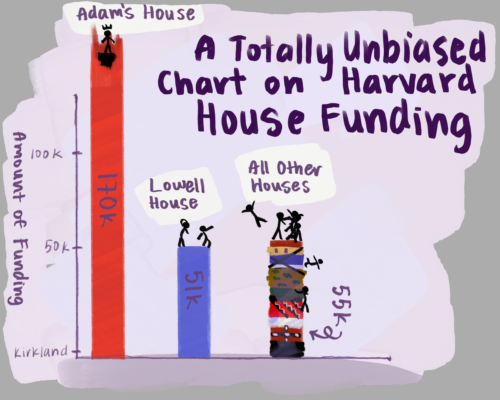
The results are in, and acknowledging my bias as a proud Adams House tenant, the day was wildly successful. The challenge drew 1,308 donations totaling $276,740.38. Of this amount, the top three fundraisers were Adams House, which raised $170,051.39; Lowell House, which raised $51,310.41; and Eliot House, which raised $11,813.29.
Regardless of the amount, any additional funding is cause for celebration. All of these donations are in addition to the standardized budget each House receives from the student activities fund.
This challenge works because of the strong ties between Houses and their alumni. “A sense of community can be a significant motivator to donate to a cause,” according to research from the Yale School of Management.
While many alumni certainly feel connected with the University as a whole, their Harvard College residential House is a particularly strong personal draw, being the space where they lived for three years during their College experience. This is also supported by the fact that graduates overwhelmingly believe their own House to be the best on campus. In the context of fundraising, it is natural for an Adams alumnus to want to give to their own House rather than to all 12. This is especially true for smaller donations; a $100 donation split into $8.33 increments is much less enticing than the full amount to a single House.
Expanding housing budgets pumps more money into inclusive spaces that benefit all affiliated students. One of the benefits that Adams has already seen is the ability to make their formal free for all students and residents in the House for the next five years.
As residents in each House fundraised, they forged direct connections with alumni, encouraging deeper engagement with the House and its students. From here, donors can join the community to see where their donations are going and offer a helping hand to students in their career fields or areas of interest.
But the reactions to the challenge weren’t all positive. In response to the results, there were critiques of the fundraising program for its potential to exacerbate “existing resource gaps.” And yes, there were certainly gaps in fundraising, with Adams raising 80 times as much as “Bouse”—I mean, Kirkland House. This vast discrepancy is, of course, not ideal. But the argument fails to take into account several factors: all Houses have a standardized fund distributed to their House Committee (which was unaffected by the results), and all Houses had the same opportunity to work with their alumni to raise funds. Many did not.
It’s important to note that much of this criticism of the challenge came only after the results were released. Funding discrepancies, for lack of a better term, are more of a “sore loser” critique than a valid criticism of the operation. It undermines a lot of the work that Adams House put into its fundraising. It wasn’t just handouts; as someone who worked with the committee firsthand, I saw a cohesive strategy that included multiple rounds of alumni outreach, student prizes, parent donations, and a social media blitz. Adams won outright, but it doesn’t have to stay this way. If the program continues, other Houses can compete more effectively and maybe even surpass Adams in future years—though I find that doubtful.
“Don’t look a gift horse in the mouth,” my grandpa used to say. In other words, don’t find fault with a gift, but rather show gratitude. This program is a great way for House committees to increase their budgets, create more positive experiences for their residents, and help students stay connected with alumni.
Beyond these reasons, the key takeaway is simple: there is no financial downside; it simply increases House budgets beyond their existing funding. So in effect, although it is a competition, there really are no losers.
In the past few months, tensions between the administration and student body have been at a high point over changes to grading, student activities fees, and other plans unpopular with undergraduates. We’ve given significant negative feedback, so it’s only fair that we recognize the administration’s positives: this year’s Housing Day Challenge was, and will hopefully continue to be, a great idea that should be sustained.
But with or without the Housing Day Challenge, my experience in Adams has already been unforgettable—and I am only a year in. The people, sense of community, and support I experience daily make me immensely grateful for this housing system. I remember anxiously waiting in my friend’s Yard dorm on Housing Day 2025 after River Run, and the elation that came when Adams upperclassmen busted in the door, chanting “A-D-A-M-S. ADAMS HOUSE IS THE BEST.”
“Some people think they are in community, but they are only in proximity. True community requires commitment and openness,” philosopher and author David Spangler once said. This is exactly what Harvard has given our alumni and us: proximity that has been molded into a true community through residents’ commitment and openness.
Kalvin Frank ’28 (kfrank@college.harvard.edu) is thankful to all 1,308 alumni who supported us.