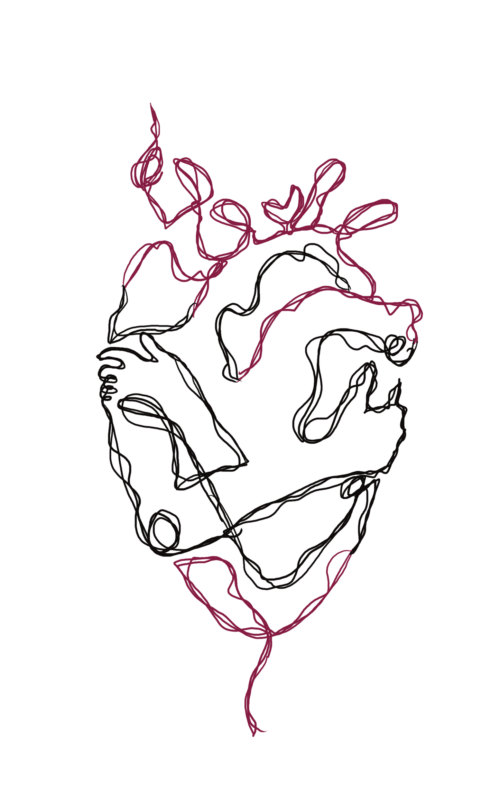
I Was Good at Loving Her, Not at Being Loved
Graphic by Amelie Lima

The first time I met her, she sat next to our mutual friend, shy and quiet. People called her “Mali,” Thai for a small, delicate jasmine flower. She was 30, ten years older than me, yet every part of her body emitted an innocent desire to be loved, to be hugged, to be protected. I wanted to be her protector.
The Thai expression เป็นห่วง (bpen huang) defined our relationship from start to finish. Huang isn’t just about worry or care, but encompasses a quiet concern and attunement to well-being. It is tender, constant, natural.
Mali couldn’t consume any seafood, fried food, desserts, or sugary drinks; even minor indulgences resulted in intense stomach pain. She was underweight at 95 lbs. Alcohol triggered her Asian flush, but five shades redder than average. She was sick three times in our first month of dating: influenza, heatstroke, and food poisoning.
During the third instance, I was in London and couldn’t be by her side. We were long-distance half of the time because I traveled internationally for work and school, while she was based in Thailand. She sent me a voice message—“V, I feel so weak, and I am all alone. Wish you were here with me,” she whimpered in a sweet, affectionate tone, as Thai people capture in the word อ้อน (ôn). I wanted to take the next flight to Bangkok. To bring her medicine, stroke her hair, and cook her warm, nourishing congee. I felt useless 6,000 miles away from her. Given a choice, I would have willingly been sick in her place.
I became increasingly fretful about her health, worried whether she was eating enough, staying active, and sleeping well. On days when air pollution exceeded 50 µg/m³, I urged her to wear a mask to protect her immunocompromised lungs from Bangkok’s smog-laden air. Before she met me, she never had the habit of putting on sunscreen, despite the scorching rays of Thailand’s sun. When we were physically together, I always remembered to apply sunscreen for her—her soft cheeks cupped between my palms as my thumb gently rubbed the cream in small circles.
Like a transdermal drug entering the body through a patch, she slowly seeped into my skin until the capillaries underneath absorbed her into my bloodstream. Soon, she was in the blood that pulsed through me a hundred thousand times a day. “Babe, how’d you sleep last night?” “What do you want for breakfast?” “Do you need a hug?” “Are you okay?” I wanted to know, and she wanted me to want to know.
The spring I went to Shanghai for work—we had been dating for around a year by then—I hadn’t seen her for three months, longer than we had ever been apart. By that point, I missed her deeply and wanted to make sure that she missed me too. So when, over the course of a few days, she stopped texting “kittung” (miss you) and didn’t call me Tirak, a common way to address a lover, I began to feel uneasy. Perhaps she did not mean to make me feel insecure and was simply not in the mood to be verbally affectionate, but I am nothing if not attentive to detail.
I asked her in a coaxing, affectionate tone—one that she often used with me, one I would never dare use with anyone unless I felt completely comfortable with them—“Babe, do you still miss me? Why don’t you call me Tirak anymore?” I naively thought she would find it endearing, that she would tell me “so sorry, Tirak,” that she’d soothe my insecurity.
Instead, she became angry. “I don’t understand why you pay attention to such trivial details. I am not the type to say something just because you want me to. If you want a girlfriend who is there to please you and sweet-talk you, I am not that girl,” she said before hanging up.
Later, I tried to call her, hoping to explain that I was only asking for reassurance, not to be dramatic. I wanted to apologize if I was asking for too much. She refused to pick up, nor did she address our conflict in subsequent texts for three days. When she finally did, all she said was: “You always put your own needs first and prioritize what you want.” I didn’t address this then, or ever, because her text confirmed my long-held belief that my needs were inherently burdensome, selfish, extractive.
That same afternoon, Myanmar suffered from a devastating 7.7-magnitude earthquake. Bangkok felt the tremors: rooftop pools turned buildings into waterfalls, a skyscraper collapsed, mass evacuations. Mali told me she sprinted down 25 flights of stairs as her condo swayed, her body in a state of panic the entire time. She then walked five miles with heavy bags until she reached her friend’s one-story house. I wanted to hold her in my arms, cuddle her, and whisper in her ear. It’s okay, dear, you are safe with me.
In the midst of it all, Mali’s ex-girlfriend had reappeared, checking in on her a few hours after the earthquake. For the next few weeks, the ex made multiple advances—a note, flowers, a request to meet. Mali told me not to worry as she would ignore her. Yet, despite early misgivings in our relationship that already revealed an asymmetry in care, the possibility that there was someone else, that she could be with someone else, terrified me.
***
When I was in elementary school, my friends liked to play this game where two people would face each other, hold hands, lean backwards, and spin in a circle. The spinning worked because we held each other’s weight in tension, leaning back just enough to keep the circle in motion. If either of us loosened our grip or lost our balance, the game would end. While for some, this game was exhilarating—the counterforce stabilized their balance, allowing for a speed they could never reach spinning alone—I found it absolutely frightening. At any given moment, my partner could let go, unconcerned that I might be flung to the side, my body hitting the hard, concrete floor of the school gym.
***
I coped with my insecurity about Mali’s ex by doubling down on huang—learning to cook new dishes, buying her small gifts, checking her data on the Apple Health app. The more useful I was, the more she would love me. As long as she depended on me, she wouldn’t leave me. She would need me, and I wanted to be needed.
It wasn’t until a month after the first attempt at contact—when the ex tried to call Mali during one of our dates—that Mali finally explained their history. She told me their relationship had been toxic: her ex liked “Toms” (Thai slang for tomboy/masc/butch) and often insisted, “Don’t come see me on the days you are a girl.”
Mali, who identified as femme but was occasionally boyish, felt compelled to make herself into a “Tom” to be with her ex. In that relationship, Mali paid for everything, managed all their affairs, and did everything she could to please her. All she asked for in return was love, but her ex did not love her.
I asked my girlfriend two questions.
“Do you still have feelings for her?”
A pause.
“I don’t know.”
“If she came back today, promising to love you, to appreciate you, would you go back to her?”
Another pause.
“I don’t know.”
***
What she did not know told me everything I needed to know.
***
Phototropism is the growth or movement of a plant in response to directional light. When phototropins, light receptors at the tip of the shoot, detect light, they trigger the redistribution of auxin, a growth hormone, causing those cells to elongate and the stem to bend toward the light.
A plant doesn’t lean toward the hand that tends it.
***
Know is pronounced like “No.” No, I will not be staying.
Know is a variant of now. Now is the time. Now I leave.
Vivian Ye ’27 (vivian_ye@college.harvard.edu) texted Mali to confirm a few details before writing this piece, only to discover that she was back together with the ex that triggered the breakup.