“Art Can’t Just Be a Luxury for the Few.”
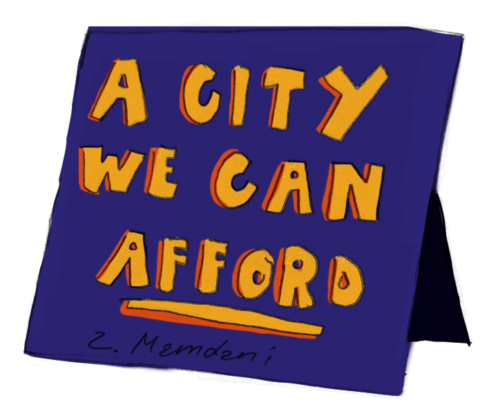
Graphic by Nuala Mernin

As a senior in high school, I watched the name Zohran Mamdani pop up in conversations across my classrooms until his election suddenly became the single most important topic of discussion among the students in my graduating class. The same question seemed to be on everyone’s mind: will a self-declared Democratic Socialist manage to get anything done as New York City’s mayor?
Mayor Mamdani has accepted our challenge head-on: after just seven months as mayor of America’s most populous city, he boasts an impressive list of successful projects. In his first 100 days in office, he fulfilled promises ranging from investing in universal childcare to fixing an annoying bump on the Williamsburg Bridge. These developments extend into the cultural sphere, as Mayor Mamdani has launched several initiatives in recent months.
As the birthplace of countless historic aesthetic movements, from the Harlem Renaissance to Pop Art, New York has long been home to the country’s artistic expression. But as gentrification and displacement drive rent prices up and push low-income residents out of their homes, the New York art world has increasingly become a realm only for the fortunate. Keeping the arts thriving and public-facing—from establishing affordable living spaces for artists to offering free museum and theater tickets—means keeping the city and its spaces diverse and equitable. Mamdani, it seems, has been committed to this goal.
In August, Mayor Mamdani announced the allocation of over $8.4 million in grants to nonprofit and small-business initiatives across the five boroughs. In collaboration with the Department of Small Business Services, the Mamdani administration distributed 89 grants to various projects, including public art commissions and arts programming. These grants, among his most exciting achievements, will support street murals and local film projects that make New York a vibrant city and bring untold stories into the American art canon.
His efforts to fund the arts were not a one-off: Mayor Mamdani and the City Council agreed to a fiscal year 2027 budget that allocated $79.1 million to restore parks, libraries, and cultural institutions. The budget includes $30 million for Cultural Community Support Restoration, addressing the inadequate funding the city’s cultural organizations have suffered. Another landmark step toward making art more affordable and accessible across the city, the 2027 budget works to make art a public good.
In February, Mayor Mamdani appointed art curator Diya Vij as Commissioner of Cultural Affairs, placing the arts at the center of his cultural agenda. “As Commissioner, I will extend the Mayor’s affordability agenda to arts and culture,” Vij said, echoing Mamdani’s emphasis on expanding equitable access to creativity and culture in the city. Vij has previously worked at Creative Time, Powerhouse Arts, the Queens Museum, and the High Line, supporting public and accessible art.
Mamdani has not only supported the production of the arts, but also their consumption. In January, Mayor Mamdani joined the Under the Radar Theater Festival in distributing some 1,500 free theater tickets to the public. Theaters have not been immune to New York’s rapid gentrification. For the middle and working classes, Broadway shows have become an annual event at best and an impossibility at worst. By distributing free tickets and enabling New Yorkers to see shows regardless of financial circumstances, Mamdani has reminded the public that the performing arts are for everyone, not just those lucky enough to afford them.
These are just a few of Mamdani’s ongoing efforts to keep art at the center of a more equal New York. Together, these projects have helped raise awareness of and support for independent artists and their crafts. Mamdani’s commitment to the arts is not only an exciting feature of his leadership strategy but also an integral component of his political identity as a Democratic Socialist.
While Mamdani is certainly not the first New York City mayor whose governing philosophy centers labor and community infrastructure, he is the first to label himself a Democratic Socialist and make that label central to his mayoral agenda. His landslide victory and positive public opinion are revolutionary achievements for American leftists, and every decision he makes—including the funding of public arts—will help shape the framework for future socialist governance across the country.
As the Soviet Union collapsed in 1991 and revolutionary political scientist Francis Fukuyama declared liberal democracy and free-market capitalism the West’s final form in his controversial book “The End of History and the Last Man,” “socialism” took on a slew of antagonistic connotations in the American mind. By declaring himself a Democratic Socialist during his campaign, Mamdani took on a considerable risk—many still believe socialist ideals to be “anti-American.” Even at my high school, an independent institution known for its progressive syllabi and leftist teachers, many students shook their heads at the idea of a “communist” taking charge of the city.
And yet, contrary to the expectations of my peers and neighbors, who imagined a New York bogged down by “backward” ideas, one of the best examples of Mamdani’s governing philosophy is his dedication to the arts. In recent decades, average theater tickets have steadily increased in price; premium tickets, introduced in recent years, have made desirable performances inaccessible; and galleries have closed their doors to both new artists and low-income art enthusiasts alike—the cultural sphere, much like the city at large, has become a realm only for the upwardly mobile. By working to keep museums and theaters open to the public, Mamdani works toward the Democratic Socialist mission of shrinking the gap between social classes in the city.
The arts are not just an interesting attraction of the city, but a foundational aspect of its diversity and national identity. Films like Spike Lee’s “Do the Right Thing” and Jennie Livingston’s “Paris Is Burning” created global recognition for marginalized groups in New York; ’70s Black hip-hop launched decades of mainstream rap music; Yoko Ono’s ‘Wish Tree’ series brought contemporary art to new audiences through its New York installations; the arts have long given voices to the oppressed, brought new faces to the city, and reminded the world of New York’s cultural and ethnic diversity. Mamdani’s efforts to fund the arts help strengthen the palimpsest of stories that make the city special.
One mural at a time, public art brings marginalized stories to the surface of the city and keeps New York the multicultural hub it always has been.
Nuala Mernin ’29 (nmernin@college.harvard.edu) is the Art Director of the “Harvard Independent.”