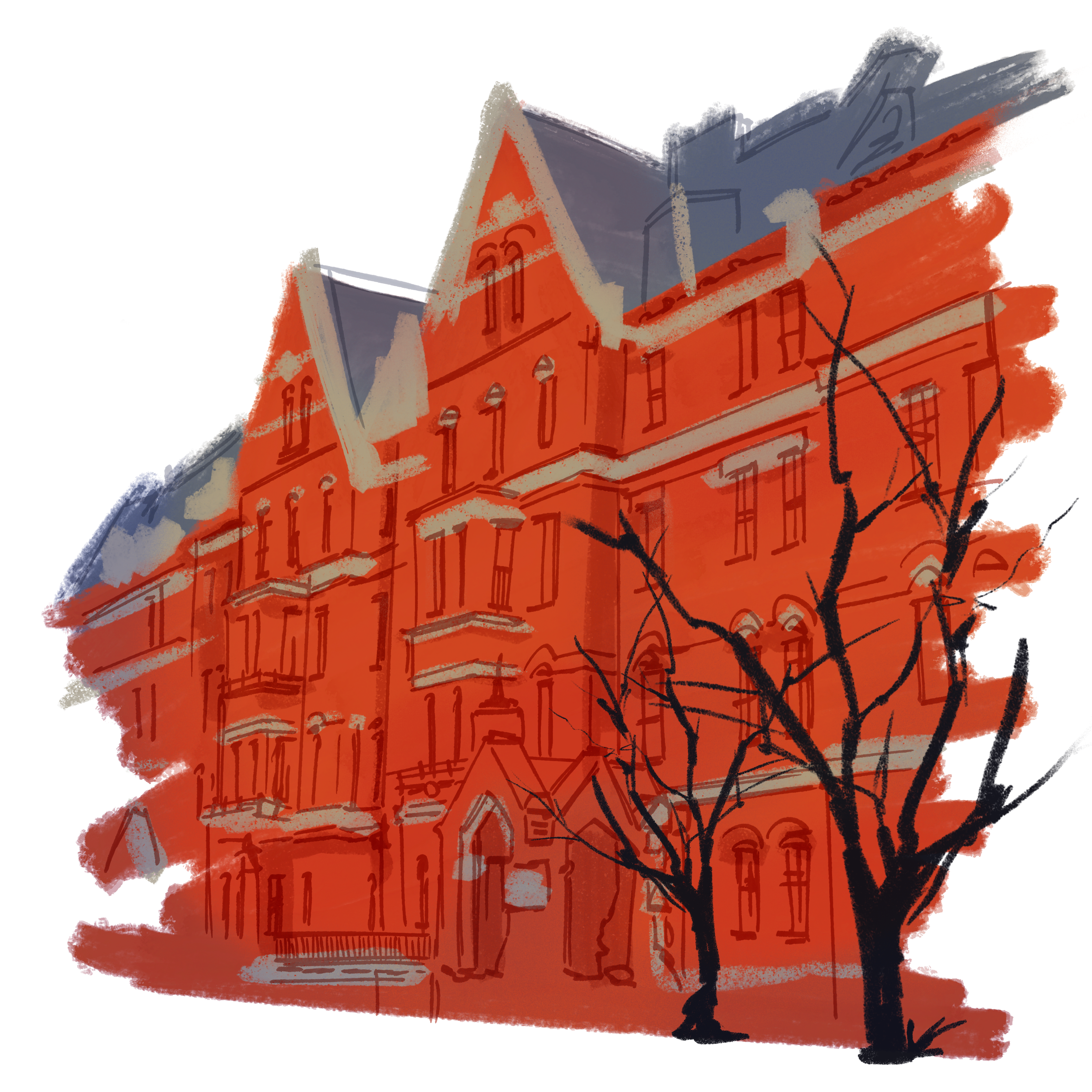
A Flashback to the History of Each Freshman Dorm
Graphic by Justin Ma

Over the past few weeks, members of the Class of 2030 have been unpacking boxes in dorms where John Adams ’1755, John F. Kennedy ’1940, Matt Damon ’1992, and Natalie Portman ’03 once lived. I spent my entire freshman year in Straus Hall before learning that the family that financed it went down with the Titanic. With many first-years nervously anticipating what dorm life will be like for the next two semesters, here is a look back at the history of each of the 17 freshman halls, in chronological order.
Massachusetts Hall
“Mass” Hall was built between 1718 and 1720, making it Harvard’s oldest standing building and the oldest dormitory in the country. Five Founding Fathers have called Mass Hall home, including John Adams ’1755 and John Hancock ’1754. Around 640 Continental Army soldiers sheltered here during the Revolution, which is surprising because today only 14 lucky first-years live in this building, making it the dorm with the fewest residents in the Yard.
Hollis Hall
In 1763, the Harvard Corporation built Hollis Hall because it concluded that students living with local families were less well-behaved than those living on campus. Like Massachusetts Hall, colonial soldiers lived here during the Revolution, and they left more behind than people realized: in 1959, renovation workers pulled five musket balls from beneath the floorboards. Leading figures of the American Transcendentalist movement, Ralph Waldo Emerson ’1821 and Henry David Thoreau ’1837 lived here, among many other famous Harvard alumni.
Stoughton Hall
The Stoughton Hall standing today dates to 1805, but the original went up in 1700. William Stoughton, who presided over the Salem witch trials, funded it. The dorm was built out of bricks salvaged from the dismantled “Indian College,” a building Harvard put up in 1655 with missionary money aimed at converting Indigenous students to Christianity. Harvard demolished the first version of Stoughton in 1781 because it was so poorly constructed. In the financially difficult years after the Revolution, the College asked the Massachusetts General Court for permission to run a lottery to fund a new building. The state-run lottery raised over $18,000. Funnily enough, the dorms today are some of the nicest in the Yard, so the replacement must have been worth it.
Holworthy Hall
Holworthy Hall was built in 1812 with the proceeds of a state lottery, similar to Stoughton. It was named in honor of an English merchant, Sir Matthew Holworthy, who gave Harvard £1,000 in 1681, the largest gift the College received in the entire 17th century.
Grays Hall
Grays Hall opened in 1863 as the first Harvard building with water taps in the basement, freeing its residents from having to get water from the pumps out in the Yard. This luxurious reputation endures today as one of the nicest dormitories in the Yard. (It’s nicknamed the “Harvard Hilton!”) Actress and film producer Natalie Portman ’03 lived here.
Thayer Hall
Thayer Hall was built in 1870 as a gift from Boston banker Nathaniel Thayer in honor of his father and brother. Before it became a freshman dorm, Thayer Hall served as a senior dormitory in the early 1900s. This was part of a larger plan Harvard President A. Lawrence Lowell ’1877 created to try to have all Harvard seniors live in the Yard. Poet e.e. Cummings ’1915 lived here.
Weld Hall
Weld Hall was built in 1871; it shared the same design firm, Ware and Van Brunt, as Memorial Hall. It is one of the largest and often regarded as the most social freshman-year dormitory. John F. Kennedy ’1940 famously lived in Weld.
Matthews Hall
Matthews Hall was built in 1872, on the grounds where Harvard’s “Indian College” stood from 1655 to 1698. The printing press inside the Indian College produced the first Bible printed in North America. Coincidentally, Matt Damon ’1992 lived in Matthews Hall during his freshman year.
Apley Court
Apley Court was built in 1897 as a private luxury dormitory for wealthy undergraduates, financed by the Claverly Trust. Notably, T.S. Eliot lived here as a graduate student in 1907. Harvard only purchased this “Gold Coast” dorm in 1920 and has owned it ever since, but the luxury still lives on today in its marble bathtubs. Adams House has famously resisted the college’s use of it as a freshman dorm, even “annexing” the building in 2025.
Hurlbut Hall
In 1914, Hurlbut Hall was built as a private apartment building called Devon Court. However, just 32 years later Harvard purchased the structure, and it became an undergraduate dorm. Its suites are among the most spacious of any freshman dorm, which makes sense for a building originally designed for grown adults rather than 18-year-old college freshmen.
Greenough Hall
Greenough Hall was also an apartment building before Harvard bought it; the dorm was built in 1922 and acquired in 1956. Like Hurlbut, it has spacious rooms, likely for the same reason. It is named for Chester Noyes Greenough ’1898, the dean of Harvard College in the 1920s.
Lionel Hall
Lionel Hall was built in 1925, and it is named for Lionel de Jersey ’15, an Englishman descended from John Harvard who lost his life during World War I. This dorm was a gift from Harvard President Lowell and his wife, Anna Parker Lowell, as part of a larger effort to expand student housing on campus.
Mower Hall
Mower Hall was built the same year as Lionel, and the two buildings mirror each other on either side of Holden Chapel. It has room for about 35 students, yet it has housed former vice president Al Gore ’1969 and Academy Award-winning actor Tommy Lee Jones ’1969, among others.
Straus Hall
Straus Hall, my own freshman dorm, was built in 1925 by three brothers as a memorial to their parents, Isidor and Ida Straus, who died on the Titanic. Harvard dropout Mark Zuckerberg famously spent his freshman year in this dorm.
Pennypacker Hall
In 1927, Pennypacker Hall was built as an apartment complex called the Roosevelt Apartments, and it did not become Harvard property until 1958. It is named for Henry Pennypacker ’1888, who ran Harvard admissions from 1920 to 1933. WHRB (Harvard Radio Broadcasting), the student-run radio station, broadcasts out of the basement, so if Pennypacker freshmen are loud enough, they’re the only ones who can hear their dorm on the radio!
Wigglesworth Hall
Wigglesworth Hall was finished in 1931 and forms the entire south end of the Yard along Massachusetts Avenue. Residents often complain about hearing the T from the basement or loud Mass Ave. traffic. The house that stood on this site before Wigglesworth was built dates to 1631, when it was constructed for the Reverend Thomas Hooker—five years before Harvard even existed. Harvard did not buy the land until 1794. Since then, hundreds of freshmen have lived in this dorm, including famous Harvard dropout Bill Gates.
Canaday Hall
Last but certainly not least, Canaday Hall became the newest building in the Yard, built in 1974. Despite being the newest dorm in the Yard, it is known for a pervasive mice problem. It lies on the site formerly occupied by the first Fogg Art Museum. The building is named after Ward M. Canaday ’1907, a Harvard alumnus and businessman. It is also the largest freshman dorm in the Yard, so more of the Class of 2030 will be able to enjoy its “modernity.”
As the Class of 2030 begins to adjust to dorm life, they join generations of students stretching back more than three hundred years, most of whom were probably just as nervous. Who knows, maybe one day a current freshman will find their name listed as a famous alumnus of their freshman dormitory.
Sonia Singh ’29 (soniasingh@college.harvard.edu) is Editorial Outreach Chair for the “Harvard Independent.”