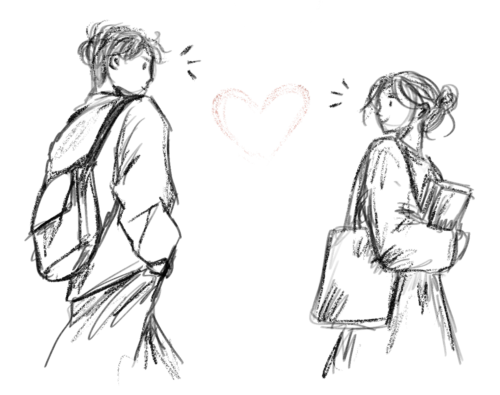
The Lost Practice of Meeting Someone Organically
Graphic by Trischelle Afihene

I have never once downloaded a dating app. Shocking, right? Nowadays, it seems like almost everyone has some sort of online dating platform installed on their phones; the ability to “make a match” just clicks away. Online dating platforms have exploded in popularity in recent years. Three in 10 U.S. adults report having used a dating app or site, and that number has risen to about half of adults ages 18-29.
My first serious relationship began at a summer leadership program during my sophomore year of high school. Although it didn’t work out, it taught me a lot about the importance of real connection that wasn’t over a screen. Without the protective shield of Do Not Disturb, I had to face the awkwardness of complimenting someone face-to-face, and I had to ask them on a date without a virtual barrier to fall back on.
I’ve sworn off dating apps for a lot of reasons, but much of it started with the fact that my first real connections weren’t made on the internet. It’s easy to fall into the trap of convenient romance when society teaches us to expect it. But with the commodification of potential partners, the decline in the search for real connection, and the lack of tangible consequences for actions like ghosting, it stands to reason: dating apps have ruined dating—the very thing they exist to encourage. Dating apps perpetuate a culture of nonchalance; disposable options and emotional detachment are replacing true connection as these platforms force real people behind a screen.
It’s natural to search for love, but commercializing your options isn’t. Society used to view marriage and courtship as means to material or social gain. Over time, as human rights advanced, marriage began to be understood in the context of love and commitment. It seems we’ve almost gone back in time when you look at the business models of modern dating apps—sites like Hinge and Tinder make money off of the average person’s quest for their soulmate. Without us, they wouldn’t be in business. Instead, they turn love into a “game”: swiping right or left based on whether you like the profile on your screen, with only the most surface-level information about a person. It’s basically doomscrolling for matchmaking.
Another increasingly common use is dating apps for hookups. Whether it be a one-night thing or a friends-with-benefits situation, sexual pleasure can outweigh the desire for a true, romantic connection when considering motives for signing up for the site. Although not the only reason, 52% of people in a study on dating app usage indicate that they have had casual sex with a partner they met on the app. In a study done by “Psychology Today,” only 23% of people report being romantically involved with a hookup partner: 11% in a casual or undefined relationship, and 12% in an exclusive, committed relationship.
Dating apps have also made dating harder. Terms like “ghosting” or “situationship” are starting to shape not only how we treat others, but also how we treat ourselves. Putting social interactions behind a screen lets us ignore someone for days instead of being upfront with them. Situationships—not really a relationship, but not really not one either—unleash a whole different beast in love lives.
What we’ve really lost from the dating scene is the art of meeting someone organically. At a coffee shop. At a dance class. Bumping into someone in the hallway. Summer camp. Someone who sits a few rows ahead of you in class. A friend of a friend. If you want to be a little risky, someone in your extended friend group. People are too afraid to take a chance on someone in their real-life circle for fear of rejection or appearing too “chalant.”
The best part of meeting someone face-to-face is being able to establish that familiarity and connection in real life. Online connections lack body language, facial expressions, good jokes, and hearty laughs in real time. You are forced to stay present instead of deferring that spark to another task on your to-do list—something busy Harvard students often struggle with.
Many Harvard students don’t really date. The “Harvard Independent’s” 2026 Love Survey shows that only 37.6% of undergraduates are in committed relationships. In an attempt to combat the loneliness epidemic, platforms like Datamatch and Match 13.5 try to matchmake among the Harvard population, but the promise of funding dates via Datamatch seems to entice students more than the idea of actually hitting it off with someone.
Those looking for more casual hookups might prefer the ease that dating apps provide, especially on hustling college campuses. It’s easier to assume that hookups coordinated on a dating app are often with people you’ll never run into in real life again. Not only is this incorrect (ask how many of your friends have seen other Harvard students on Hinge—it’s a lot more than you’d expect), but it also takes away the thrill of an in-person spark with someone; it requires you to evaluate your chemistry with someone’s virtual profile, not their real persona.
Students avoid matchmaking with classmates because they fear how they’ll be perceived. They’re afraid of entering any situation where anything might be even slightly unexpected. You might not always be someone’s cup of tea, and that’s okay, but letting it dominate your life hurts you in the long run, even if it feels like “protecting your peace.”
Even this worry of imperfect matchmaking is alleviated by meeting someone out in the wild. It’s easier to gauge compatibility right from the first interaction and see if you have that “spark” everyone talks about; it’s hard to perceive personality over text.
People are so scared of rejection or awkwardness that they stop putting themselves out there. They make excuses about only doing things “for the plot,” ghosting or getting ghosted, and tearing others down to make up for a not-so-great date experience. But that’s exactly what makes life so exciting. It’s healthy to have those experiences sometimes, and it’s character development to experience a setback every once in a while, even in your dating life.
So, go out into the world. Ask out your section crush. Make a move on that person you keep running into on your walk to class. Let a mutual friend set you up on a date or two. Get comfortable with being uncomfortable and put yourself out there a little—I guarantee you’ll have a much better story to tell at your wedding if things do work out.
Annelise Paczesny ’29 (akpaczesny@college.harvard.edu) hopes to meet the love of her life “in the wild” instead of on Hinge.