Who Are We Having Sex For?
Graphic by Linden McCarl

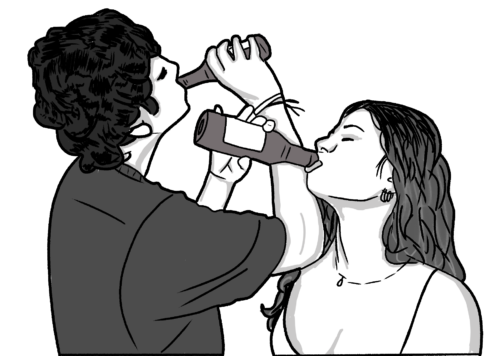
In college culture today, “hooking up” involves more than simply having sex. Rather, sex has become equated with performance, and friends share details as a way to show off their desirability and maintain social capital. College is supposed to be the place where people find their identities and explore their sexuality, but this exploration rarely happens in a vacuum. There are expectations about how much sex one should have and who it should be with. If sex is supposed to be an expression of personal desire, then why is it so often a social performance?
The Cornell 7 case shows how much sex can become a social performance. One of Jane Doe’s alleged assailants was her friend, who texted her after the alleged assault, “apologizing” for what he had done, and then later disinvited her from a Chi Phi Halloween party.
On Oct. 19, 2024, a young woman arrived at the Chi Phi Fraternity house. According to a civil lawsuit filed in September 2026, she was allegedly given ketamine and sexually assaulted by multiple fraternity members while incapacitated. While Jane Doe was incapacitated at the house, one of the men sent a Snapchat message to the frat group chat inviting other members to “come get ‘free pussy.’” In September, Jane Doe filed a civil lawsuit against 7 former fraternity members and Cornell University, alleging that they had drugged and sexually assaulted her. The tragedy of the Cornell 7 has sparked national and worldwide conversations about hookup culture.
The Cornell 7 controversy exposes the broader dynamic of treating sex as something to accomplish, collect, or use to gain status. As college students, I think we need to recognize what hookup culture has been rewarding all along. Hookups have recently become ingrained in college social life, with parties acting as primary locations for casual encounters. Meanwhile, a National Bureau of Economic Research study on hookup culture showed that partying also increases the incidence of rape due to increased social contact and substance use. These potential pathways are supported by statistics indicating that over half of incapacitated rapes and a quarter of forcible rapes take place in such settings.
Now, the facts are not all negative. The growth of college parties has contributed to sexual liberation since the 1960s. But the difference between sexual liberation and sexual entitlement is important to distinguish. Sexual liberation means feeling free to explore one’s identity and making sexual choices without judgment, whether sex is casual, monogamous, or non-existent. In contrast, sexual entitlement entails a belief that one person’s body or attention is something that is “deserved.” Sexual entitlement can become part of the performance of masculinity; people can act as though they deserve sexual access to someone to prove their “manliness” or gain approval from their friends.
There is something deeply troubling about a culture where people act as if someone else’s body is an object of desire and something they can “have.” In the Cornell 7, sexual entitlement was frighteningly prevalent.
I was utterly disgusted when I first read about the Cornell 7 case. As a woman in college still adjusting to living away from home, the story genuinely scared me. I can say from experience that college parties are not just an excuse to drink and let go; they also serve as a way to branch out without as much anxiety or pressure. Since this case broke, I have started thinking about the importance of surrounding myself with people I trust when I go out. However, the burden of preventing sexual assault should not fall on women alone.
The case also raises questions about casual sex and hookups. In my opinion, “casual” hookups are not inherently bad. It is the adjacent culture, one that makes men feel they need to prove themselves to their peers, that is the problem. And especially after the Cornell 7, it seems like casual sex may not be so casual anymore. I was horrified by the leaked messages from the Chi Phi group chat. What scared me most was that none of the guys involved were reported to have tried to protect Jane Doe. They all shamelessly treated her in such an inhumane way, revealing the current cultural separation between using sex as a way to have an emotional connection and treating it as mechanical and disconnected. The men allegedly joined in her assault to feel the pleasure of power and domination, but also to gain approval from the other members of the fraternity, some of whom allegedly encouraged the assault.
In our current world, sex is currency, and the intimate act seems to be veering away from an expression of sexual desire and toward a social performance. The emotional connection and passion involved in sex are lost when sex is framed as merely a goal to achieve. I’ve heard conversations between guys asking if they “went all the way” with a girl; a simple nod garners a round of applause and fist bumps. Not all casual sex is necessarily performative, but in a culture that rewards sexual achievement, the meaning of sex is changing into a mechanical act that someone needs to accomplish rather than a form of communication, vulnerability, and desire. It becomes a way to garner personal confidence and validation from peers.
This pervasive performativity generates a double standard for women. They are expected to be sexually available and experienced but are then shunned when they dress a certain way or are too sexually active. As men use sex to gain social status, women are forced to navigate the contradictory expectations around it. I should be able to express myself freely and explore without worrying what people say about me.
According to a study published by the American Psychological Association, 78% of women and 72% of men in a sample of 200 Canadian undergraduates reported regret following an uncommitted sexual encounter. This isn’t to say that casual sex is inherently harmful or always leads to regret, but it raises questions about what makes these experiences feel negative afterward.
Since reading about the Cornell 7 case, I’ve become much more aware of my surroundings when I go out. I will continue to surround myself with people I trust, pay attention to what I drink, be mindful of who I talk to, and avoid walking alone at night. But the burden of preventing sexual assault should not fall on women alone, and I should not have to live with the fear that those precautions are the only thing standing between me and sexual assault. The alleged perpetrators and the communities that tolerate such behavior should bear the burden, not the victims.
But perhaps more than all, this story—one of so many— should prompt a broad reconstruction of how students approach sex, especially in party settings where alcohol and social pressure are present. Perhaps its biggest consequence will not just be more caution around hook-ups, but setting intentional boundaries in relationships and reframing sex in terms of intimacy and vulnerability rather than a performance for others.
I have started to feel like sex is becoming defined by and for people who aren’t even involved in it directly. College should be a time of exploration, but that is not possible unless the culture we create embraces exploration rather than quantifying and judging it.
Anna Mogel ’30 (amogel@college.harvard.edu) is comping the “Harvard Independent.”