At Last, and Too Soon
Graphic by Ella Cohen

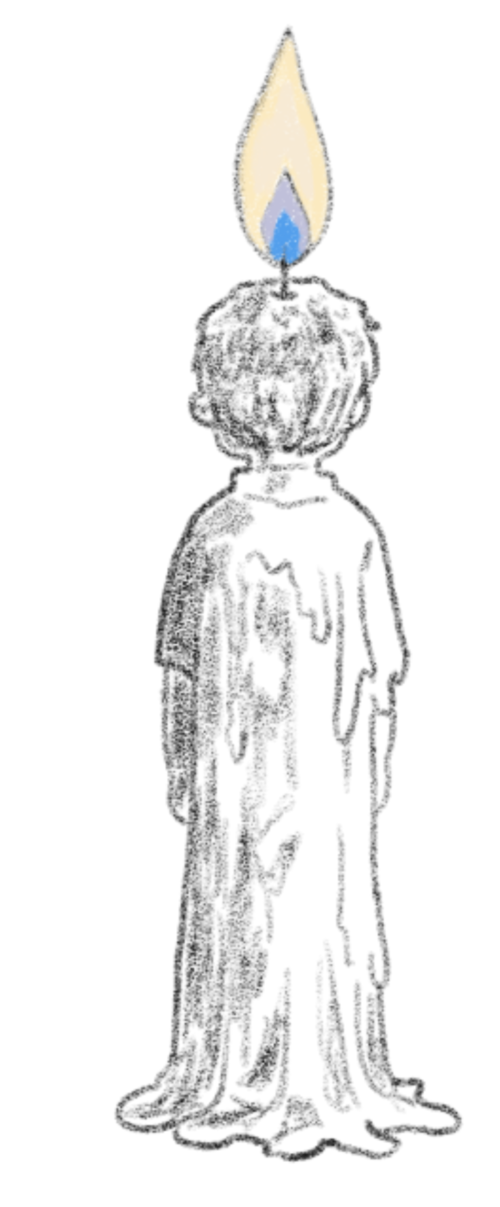
I recently read an article in the “Washington Post” that covered the war in Ukraine. It detailed the devastating reality of war and the depth of the collective grief and suffering in Pryluky, Ukraine, following the killing of the civilian Ivanchenko family. Oleksandr Ivanchenko, his wife Yuliia, and their two young children, Iryna and Maksym, died on Wednesday, Oct. 7. They died in their sleep, and now, in their eternal sleep, I can only pray they find the peace nearly five years of invasion robbed from them.
The senseless attack that took the lives of the Ivanchenko family also killed dozens more, including five children. All death in war is a tragedy, but it is the children I intend to focus on. Yulia Holoma, a colleague of Oleksandr, spoke powerfully, as detailed in the “Post” article, on the loss of Iryna and Maksym, stating that “[Russian aggression] took two children who never had the chance to know life.”
Sitting with that statement, I wonder to myself what it is like to “know life.” I’m sure these are questions that philosophers have and will continue to argue for centuries. However, it is clear to me what life should not be. Life should not be cut short at 13, in Iryna’s case, and 8, in Maksym’s, simply because they were born in a country another nation mistakenly thinks it has the right to take. Of course children die all the time; illness and accidents take countless beautiful children before they get to know life, but there is nothing natural or accidental about a Russian cruise missile striking a residential building while its residents slept.
Iryna and Maksym were two of five children who lost their lives in that attack. The Ivanchenkos were one of three families killed, and Pryluky was another city brought to its knees in this conflict that has seen thousands of child casualties and innocent Ukrainian civilians victimized by the war. Numbers often detach us from the devastating reality of war, which is why I focus on Holoma’s words.
At times, peace seems a hopeless endeavor in a world ruled by conflict. War, death, and violence, for better or for worse, are so easily accessible in the modern day. We can open Instagram Reels and, with a click, be transported to the war zone of our choice to watch intensely graphic footage. Then we swipe off and on to some AI slop, thinking nothing more of the father, son, mother, aunt, sister, or whomever we just watched lose their lives.
Do I have a solution for this? Of course I don’t, just as I wouldn’t know where to start on the path to peace. However, I do believe saying nothing is just as bad as seeing it all and swiping away. We should know their names, and we should stare conflict in the face without having the option to look away when we feel uncomfortable. War, though I have never known it myself, is terrifying. It is one of those rare things with little to no beauty. Amongst the rubble and shattered family photos strewn across empty streets that were once so full of life, despair and hope for better days lie, but rarely any beauty.
I often think of Mary Oliver when I approach topics of intense emotion because she balances grief and wonder without letting one cancel out the other. I referred to “The Summer Day” in a previous article, where I spoke on the poem’s last line: “Tell me, what is it you plan to do / with your one wild and precious life?” This time, however, I want to focus on the two lines before it: “Tell me, what else should I have done? / Doesn’t everything die at last, and too soon?”
Oliver, in her own way, admits that every life ends, often sooner than we would like. While this is true, the reply’s truth doesn’t really matter. Knowing that every life ends doesn’t explain why so many innocent children, many of whom knew their parents only as “mama” and “papa,” leave so soon. Some children didn’t grow old enough to know their parents’ real names, let alone what life was like. It’s depressing, and it should be.
I often think about Oliver’s question, “Tell me, what else should I have done?” as something I would ask God if I ever got the opportunity to. Reflecting now, however, “What have we become?” is probably a much better question to ask, since it isn’t a question for God but for humanity to reckon with and answer ourselves.
Noah Basden ’29 (nhbasden@college.harvard.edu) has no funny words for this one.