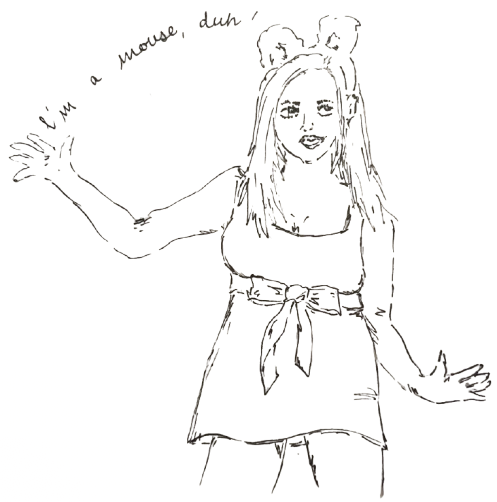
Is the Bunny Costume a Problem?
Graphic by Annabella Burton

Let me ask you a question: What do you associate with Halloween? You probably said candy, costumes, trick-or-treating, horror films, fake blood, or pumpkins. And I am sure some of you are looking for costumes—the uber-prepared may already have a Pinterest board ready. Naturally, today’s young adults turn to social media for ideas. But imagine this scenario: you are scrolling through TikTok, and you find a video of a ghost costume for women, though instead of a sheet with holes, this one has a deep V-neck and a short skirt. Hypersexualized Halloween costumes are everywhere, and they are culturally encouraged. In my eyes, this normalization can lead to worse mental health or self-esteem.
The problematic nature of these costumes does not lie in their existence—women can wear revealing and sexy outfits without it being a problem. The problem is that society encourages youth, especially young women, to flaunt their bodies to gain peer acceptance. Even those who prefer different attire opt for the slip dress and fishnets to avoid being deemed a “black sheep.” The media exacerbate and reinforce this trend.
I am sure everyone is familiar with this line: “In Girl World, Halloween is the one night a year when a girl can dress like a total slut and no other girls can say anything about it. The hard-core girls just wear lingerie and some form of animal ears.”
“Mean Girls” protagonist Cady Heron, however, expects her school to be the antithesis of this culture. She walks into a Halloween party in a truly scary Halloween costume, only to find everyone else in tiny skirts and corsets.
While the scene itself was meant to showcase the difference between the main character and her peers, the underlying narrative is more powerful. Her choice to don a comparatively “conservative” zombie bride outfit—for a 16-year-old—should not have been comical. However, her peers all fell prey to the hypersexualization trend, making Cady stick out like a sore thumb at her first social gathering of the semester. But let me ask you: Do you think everyone else at the party was comfortable in body suits and bunny tails?
Now, I understand that sexual expression can be a source of confidence in many ways. A century ago, women were taught to hide their bodies. Now, many use bold expression to reclaim their place in society and unflinchingly reject sexist norms.
But the problem arises when everyone else is pressured to conform without really wanting to. This pressure also limits options for those brave enough to go against the grain. In any Halloween store, women’s costumes often follow the same pattern: tight fits, short skirts, and deep cuts. The situation worsens when shoppers notice that the sexualized costumes are often more elaborate than the others.
The men’s costumes do not follow this pattern. Men are offered many loose-fitting, high-coverage options (well, apart from the superhero jumpsuits).
Have we reversed course on sexual expression so thoroughly over the past century that we are back to gender discrimination, this time through expectations about sexuality? And what are we teaching young girls who are trick-or-treating when teenagers and college students run past in flimsy fabric? How long will the Tinker Bell dress from Party City last when young girls’ role models are all shopping at Edikted and Baby Boo?
Ultimately, the culture of sexualized outfits functions as a form of peer pressure for many, as seen with newcomers like Cady, who are merely trying to fit into new communities.
Halloween, one of the most anticipated nights of the year, should be a great opportunity to connect, especially for incoming students early in the academic year. Young people should not have to worry about the pressures that accompany costume culture.
At Harvard, impostor syndrome is already rampant from the classroom to extracurricular activities. What happens when social spaces are no longer an escape from a culture of expectations? And what about international students who feel like fish out of water in everyday situations, like seeing plaid pajama pants and what look like house slippers in crowded lecture halls? Social scrutiny is particularly prevalent among first-generation and low-income students, who are thrown into a world of potentially uncomfortable social standards.
At the end of the day, Halloween costumes, even hypersexualized ones, let people express themselves and show their creativity and confidence. For some, such costumes may boost confidence and make them feel a little more beautiful. In this sense, there is nothing wrong with others choosing to wear the short pleated skirt or the sheer long-sleeved top. We just need to make sure those who do not feel comfortable being overexposed have the option to wear something that does not make them feel awkward or negatively affect their self-esteem. This can be achieved by normalizing non-sexualized costumes on Halloween and bringing more well-designed, high-quality options to stores. Until then, this culture of hypersexualization continues to perpetuate a harmful narrative.
Anna Gunko ’30 (agunko@college.harvard.edu) is comping the “Harvard Independent.”