Clavicular, Looksmaxxing, and the Price of Online Influence
Graphic by Tess Harris

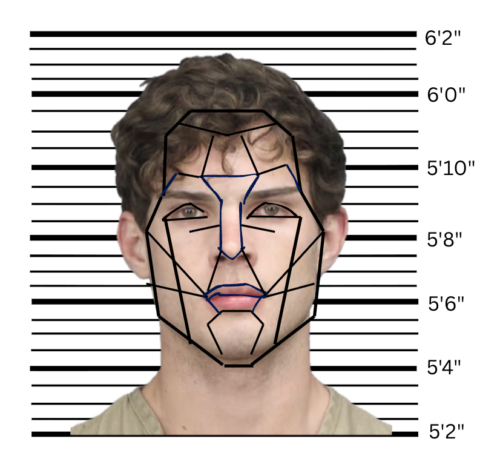
Braden Peters, better known as the social media influencer Clavicular, has built an online persona around pursuing physical attractiveness. Now, criminal charges in Massachusetts, which allege he raped a 17-year-old, have brought a different kind of attention to the 20-year-old streamer. Harvard researchers and students describe him as a symptom of a culture that sells insecurity back to young men, recognizing his transformation and the market that has grown around him as a harmful narrative, now popularized into a fad.
“What young men are being told through social media is that their appearance is what is most important about them,” said Bryn Austin, a researcher and professor at the Harvard T.H. Chan School of Public Health and Boston Children’s Hospital.
In September, Massachusetts authorities charged Peters with rape, drugging a person for sexual intercourse, and procuring alcohol for someone under 21, in connection with an alleged May 2025 incident involving a 17-year-old girl. Aleksandra Vasilevna Mendoza, known online as Alorah Ziva, told police Peters invited her to his family’s home in Chatham after they connected on Instagram. According to the police account in NBC News reporting, Mendoza alleged he gave her alcohol during a livestream and that she woke to find him having intercourse with her without consent. Peters has denied the allegations, and the case is pending.
In April 2026, Mendoza filed a civil lawsuit against Peters in Florida alleging battery and intentional infliction of emotional distress. She amended this lawsuit in October to remove her explicit sexual-assault allegations, as her attorney stated those claims belong in the separate Massachusetts criminal prosecution.
Separately, Peters was arrested in Florida for misdemeanor battery and criminal conspiracy to commit battery following a March arrest for allegedly filming and encouraging a fight between two women the month prior, and later shared the footage online. Prosecutors declined to pursue those charges in July, citing insufficient evidence.
Peters’ content centers on “looksmaxxing,” an online subculture focused on maximizing physical attractiveness through grooming, fitness, cosmetic procedures, and, in some cases, more extreme practices. Across livestreams and short-form videos, Peters discusses appearance, evaluates physical features, and interacts with others, including women, whose attractiveness he sometimes assesses in front of his audience. Clips from these exchanges circulate widely on social media, reaching viewers who may never watch his full streams. One February clip, in which Peters meets a muscular Arizona State University Student, has passed 16 million views on X, and a meme-tracking site logged 13.5 million views in its first three days.
Peters belongs to what researchers call the “manosphere,” an umbrella term for online communities and influencers that often promote misogyny and anti-feminism. Its best-known figure is Andrew Tate, a British-American former kickboxer whose short TikTok videos made him a global name in 2022, before Meta, TikTok, and YouTube banned him.
Looksmaxxing itself grew out of “incel” forums, spaces where men blamed their romantic and sexual failures on women’s supposed preference for certain physical traits. Peters has walked out of an interview when asked about his relationship with Tate, and the two men’s legal troubles now rhyme. Tate was indicted in Romania on rape and human trafficking charges in 2023 and, according to Sky News, was indicted this September again on charges that include trafficking minors. Like Peters, he denies wrongdoing.
Dr. Sergio Imparato, a Harvard government professor who teaches moral philosophy, first read about Clavicular in the “New York Times” and brought looksmaxxing into his Gov10: “Foundations of Political Theory” lectures on virtue ethics. He identified two trends fused together in this cultural phenomenon to the “Harvard Independent”: “a trend that strongly emphasizes looks, appearances, as giving worth to human beings, [and] … a trend towards maximization, towards optimization.”
Together, Imparato explained, they treat one’s face as a measure of their personhood, telling them to improve it continuously. “Clavicular basically argued that he would rather lose his virility than his hair, and by virility, he used an expletive speaking about his sexual organs, basically, which to me was… quite interesting,” Imparato said. “[A] philosophical understanding of… oneself that is grounded primarily on appearances may lead to a devaluation of the dignity of the person, first in oneself … and unavoidably in others.”
A July 2025 Common Sense Media survey of more than 1,000 boys ages 11 to 17 found that 91% regularly see messages about body image or appearance and 73% regularly see “digital masculinity” content about fighting, building muscle and making money. 68% said that content showed up in their feeds without them searching for it. The more boys saw, the more their appearance concerns grew: 14% of high-exposure boys reported low self-esteem, compared with 5% of low-exposure boys, and 41% said social media makes them feel they should change how they look, compared with 9%. Separately, a study of more than 3,000 young men ages 16 to 25 in the United States, United Kingdom, and Australia found nearly two-thirds regularly engage with masculinity influencers.
Roberto Olivardia, a clinical psychologist and Harvard Medical School lecturer who studies body image, sees that erosion happen in his office. He asks his young patients which influencers they follow on social media and the kind of content they interact with. Many are lonely and want acceptance, he said, and looksmaxxing promises belonging if you look a certain way. “You want to optimize, optimize, optimize,” Olivardia said to the “Independent,” describing a loop with no end.
Additionally, Olivardia sees patients with social anxieties, depression, and traumatic histories. “[They feel a] sense of real inadequacy or insecurities about something, who then overcompensate[s] by [believing that] ‘if I look perfect then I am perfect.’”
What worries him is that many people within the looksmaxxing community selling this blueprint have no medical credentials or experience, influencing boys and young men on a psychological level.
On campus, this cultural phenomenon’s appeal is even easier to spot. “Looksmaxxing addresses a very valid critique of society in the sense that society is very looks-based,” Audrey Han ’30 noted. She argues that Peters’ own makeover shows something attainable for boys and young men: if they follow his lifestyle, their appearance will improve and, subsequently, their lives will.
By Peters’ own account, that makeover includes bonesmashing, hitting the face with a hammer or fist to microfracture bone in the hope it heals thicker, and peptides, short chains of amino acids the body uses to send signals between cells. Some peptides are FDA-approved medicines, though the ones sold online for looksmaxxing are often unapproved “research-grade” products. Peters has described hitting his own jawline with a hammer and discussed taking unprescribed peptides. A recent peer-reviewed analysis found searches for “bonesmashing” rose about 5,000% in a year.
“I think a lot of people are unsatisfied with their life,” Han said. She sees looksmaxxing as one way people cope with that dissatisfaction. Additionally, Han traces the culture to the forums where it began. “Looksmaxxing comes from the sort of incel forums and this place where women are very regularly dehumanized or sort of subjected to objectification,” she noted. She feels that not liking one’s bone structure holds a valid argument, though the entitlement of sleeping with a woman due to one’s appearance is a completely different thing. Belief in hypergamy—the idea that women chase the best-looking men—feeds that entitlement, and Peters’ hyperfixation on his own appearance instills a sense of superiority, that he is better than everyone else, according to Han.
Austin said her clinician colleagues at Boston Children’s Hospital have been alarmed by recent cases of boys and young men arriving at the emergency department with injuries tied to these kinds of practices promoted on social media.
Austin sees an old pressure finding a new audience. “This is the kind of messaging girls and young women have been getting for decades. It’s now targeting boys in a way that it has never before… and it’s through looksmaxxing,” she said. She notices that the most valued physical traits within the looksmaxxing community are often associated with white European heritage, reinforcing racist ideals about male attractiveness. For boys facing loneliness, body insecurity, and struggles in school or the economy, she said, looksmaxxing offers a solution that feels within their control but fails to address the real problems. “This is a distraction of the most supreme kind,” she insisted.
Denise Pan ’29 sees this cultural movement happening on her own feed. On her TikTok “For You” page, she has come across peptide sellers who cite lab results she does not trust. “None of it is regulated in any way. You could literally just be buying vials of water,” she said. Creators promoting the products list discount codes on their profile bios, and she sees the entire market as a way to exploit insecurity. “I just think it’s just a big scam and scheme to get people who are insecure about their looks to spend even more money,” she said. Stanford Medicine research confirms these risks: peptides sold through the unregulated online market can carry contaminants, and many lack safety data.
Austin believes the largest profits go to the platforms. “Clavicular would not be Clavicular; he would still be just Braden Peters if it were not for the social media algorithms pushing his content out,” she said. She cited a “Guardian” investigation in which test accounts posing as teenage boys were served misogynist content within hours or days. She also noted that algorithms place extreme material beside ordinary fitness advice, so a video on injecting unapproved peptides sits next to one on eating three healthy meals, making extreme practices look more routine.
That credibility complicates the allegations, Olivardia said, because followers who feel a relationship with an influencer can struggle to reason with accusations. “There’s this sort of almost fake relationship with social media… even the idea you’re following someone, you know,” he remarked. After Tate was charged, he recalled, some patients condemned the allegations but kept following him for his physique and discipline. Olivardia then compared the pattern to the Bill Cosby sexual misconduct scandals. “It was really hard for people like myself who grew up in a generation where he was like America’s favorite TV dad to imagine this happening, but both things can be true.”
Pan has seen both grave and lighthearted posts about the charges against Peters.
Platforms have taken limited action so far regarding broadcasting regulations. Kick, the streaming site where Peters live streams, removed him in December after a livestream appeared to show him hitting a man with his car. Lawmakers are focusing on who can interact with these platforms. Australia’s ban on accounts for children under 16 took effect in December, and platforms have since removed about 4.7 million accounts. The United Kingdom government has announced plans to raise its minimum age to 16, while the Massachusetts House voted 129 to 25 in April to bar children under 14 from social media and require parental consent for 14- and 15-year-olds. Supporters have acknowledged that similar laws in other states have faced First Amendment challenges.
What platforms should do about it divides the sources. Austin favors stricter rules. “It’s something that we need stronger regulation to keep [tech companies] from being able to exploit young people the way they do,” she said.
Imparato supports similar age limits. “I would support, for example, the idea of setting an age limit for… the use of certain social media. 16, maybe 18.” He is more hesitant about removing creators over allegations alone. “I would be a little bit cautious in imposing limits on the basis of allegations alone.” If a creator has been sentenced, he said, limits on their platform make sense.
Pan disagreed that platforms should be the ones to decide. “I think the platform doesn’t have that responsibility; I think it’s more up to the consumers.” She would, however, “support countries taking creators off if the country has laws around censorship.”
“Allegations of sexual violence [are] part and parcel with what [looksmaxxing] is pushing out into the world,” Austin said.
However, Imparato would not go that far. “I don’t want to speculate over the extent to which… looksmaxxing led to criminal acts because [I] really don’t know if that is the case,” he said. Nothing in the allegations establishes that looksmaxxing led to any criminal conduct, and Peters has denied them.
Madi Kang ’29 (madisonkang@college.harvard.edu) is comping the “Harvard Independent.”