Harvard is a Hashtag
Graphic by Isra Khan

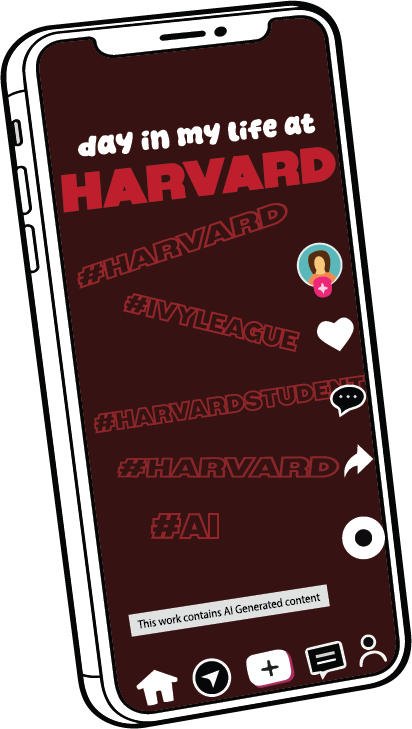
Jenny Ng ’28 was scrolling on her phone one evening when a “Day in My Life at Harvard” video appeared on her TikTok “For You” page. At first, she didn’t think much of it; the genre has become a staple of college social media, and she likes supporting other creators. Then, she kept swiping. The next slide showed the creator sitting in class, carrying a tote bag that looked like Ng’s. She also had the same pink Stanley cup, down to the same straw lid. “I was like, ‘This is sus,’” Ng said to the “Independent.”
The frames looked familiar because they were. They were taken from a viral video Ng made as a first-year, then run through artificial intelligence to put a stranger’s face over her own. Ng said the rest of the account was fabricated too. “None of her life made sense or lined up,” she explained.
Ng screenshotted the account to remember to return to it once more salient tasks were completed. Later that week, bored before dinner, she recorded a reaction video in under two minutes. Within about 40 minutes of posting, it had more than 100,000 views.
She had a hunch it would be big. “I know that AI and Harvard are two very big hashtags and buzzwords that push content out,” she admitted.
Both her video and the stolen content serve as—albeit unusual—examples of a broader trend: using the Harvard name to drive online attention—a trend that has endured for more than a decade.
In 2022, Harvard Magazine profiled the school’s student influencers, including Hanna Evensen ’16, who began posting YouTube videos as a first-year in 2012 and found that viewers responded much more to her Harvard videos than to her other content. That same year, a TikTok by Abigail Mack ’25 about her Common Application essay was viewed about 20 million times.
That appeal has carried over to today’s student creators, including Harry Eisenhardt ’29, who started posting last fall. He makes health and wellness content, some of which is educational.
Eisenhardt didn’t include his Harvard attendance in his content until the summer, and even then, he said, the name wasn’t central. “It’s just a name that I use at the beginning of it, more to get attention within the first three seconds.”
Initially, his experience complicated his assumptions. His first viral video mentioned Harvard, which led him to believe there was a clear formula for content success. “I originally thought, ‘Wow, it actually makes a difference,’” he said. “And then I kept posting with it, and it didn’t really make much of a difference in the attraction that content got.”
These opening seconds carry heavy weight on short-form content platforms where viewers can move on with just a single swipe. Research from Influencer Marketing Hub found that 71% of TikTok users decide within the first three seconds whether to keep watching. “If somebody’s attention is grabbed and then they see the name, it might be beneficial for retaining attention,” Eisenhardt explained. “But if somebody’s attention isn’t grabbed in the first seconds, I don’t think it’s going to do much to change that.”
Ng, by contrast, credits the name with opening doors. She began making content before arriving at Harvard, but she started investing more time in it during the spring of her first year. She signed with an agency that summer when she had to treat it as a real responsibility, she said. “I still use the Harvard name. I mean, it is synonymous with my life,” she said.
Her content falls mostly in the lifestyle space: one of her most viral videos was a “day in my life” vlog from her first year, and she also posts study tips and her opinions on life at Harvard. Content about Harvard as an institution, she noted, is easy to find elsewhere. “If someone wanted to watch a tour of Harvard’s campus, they certainly could,” she said.
Ng does not downplay what the Harvard name has done for her: “I’m not going to pretend Harvard wasn’t a reason that I got to the level of success I have now on the internet. I’m not going to pretend I did this all by myself, my personality.”
Still, she argues the name only goes so far, especially given that so many Harvard students post online. “If it’s just Harvard, then there are so many creators that people could support,” she said. “I think what people stay for [in] my content is probably the vibes and the type of character personality I portray,” Ng continued.
Ng’s view reflects the algorithm-driven side of the work. Years of posting have given her a sense of when a video will perform, and that deviating from a usual format can backfire. The first hour indicates what will come: if a video passes a thousand views quickly, it is likely to take off, she said. Her AI video, which doesn’t follow her typical format, followed that pattern.
Both Ng and Eisenhardt acknowledged that the name “Harvard” carries assumptions, and both had reservations about them.
Eisenhardt said that the Harvard name makes people more likely to trust what he says because of what they believe the school represents. Still, he does not think it should. “I could be an Econ major and start giving advice about physics, which has no real correlation,” he said. “If I’ve never taken a physics class before, and I’ve never done any research about it, going to Harvard doesn’t really show much about my knowledge.”
Eisenhardt also understands the other side, that some viewers read the name as an inherent flex. “A lot of people may think that you’re arrogant or using it to show that you’re smarter than somebody else, which is not the case,” he said.
Harvard is not the only school whose name travels online. A 2021 Yale Daily News report found that videos tagged #yale drew a combined 124.2 million views, top videos by Yale students averaged about half a million, and creators felt the school’s name boosted their content. Still, Harvard’s brand may carry more weight than its peers’. In the same 2022 article, one Harvard creator told Harvard Magazine that some audiences recognize Harvard’s name but not Columbia’s or Yale’s, and arrive with strong assumptions about what Harvard students are like.
Ng described the same tension as “a double-edged sword.” The school gives her credibility on topics like study tips and life advice. “I did a random get ready with me where I talked about my take on being single, after a breakup, and it actually resonated with a lot more people than what I was expecting,” she recalled. “People almost assume that I’m a bit wiser than someone else.”
But those expectations come with a catch. “People expect that I can never say anything grammatically incorrect. I can never be wrong,” Ng said. If she missteps or shares a nuanced opinion, the comments quickly turn critical.
“The people that support me, I think, really value what I have to say,” she said. “But then the people that attach me more so to the Harvard name and don’t really know me as well want to find any reason to tear me apart.” She said she tries not to dwell on it.
On campus, neither creator reported much pushback from their peers. Eisenhardt said he hasn’t heard direct criticism, though friends have told him some people see creators differently. “It’s not really that big of an issue,” he explained. “I don’t really think it matters.”
Ng said most people are relaxed about it because content creation has become so normal. “It’s really hard to know anyone that doesn’t know someone personally that’s trying to create content online,” she said.
The data agrees with Ng’s observation. Goldman Sachs Research estimated in 2023 that there are about 50 million creators worldwide and expected that number to grow by 10-20% a year. Interest runs especially high among young people. A 2023 Morning Consult survey found that 57% of Gen Z respondents want to become influencers, compared with 41% of adults overall, and over half of Gen Z respondents consider it a respectable career choice.
Ng also noted that she arrived at Harvard already making videos, which she thinks made classmates more accepting. “I don’t think I project anything that’s something that people can really have a bone to pick with,” she added.
Her videos also reach people outside her peer group. After her AI video spread to Instagram and YouTube, Ng said a teaching fellow mentioned it in a discussion section, and her Chinese professor said he had seen her videos on his own feed.
Despite having her content stolen online, Ng said she was not especially upset. In her view, posting publicly means accepting people can do what they want with your content. “The internet is just an abyss,” she said.
The AI-generated account that copied Ng’s videos also reminds us how much weight the Harvard label carries online—enough that someone built a fabricated student around it. For Eisenhardt, the name is a three-second hook that may or may not matter. For Ng, it opened a door she says she now must keep proving herself to earn her way through.
“Can AI recreate this beautiful personality?” Ng said. “I think not.”
Mala Brumm ’30 (mbrumm@college.harvard.edu) is comping the “Harvard Independent.”