Economical Emotions
Graphic by Trischelle Afihene

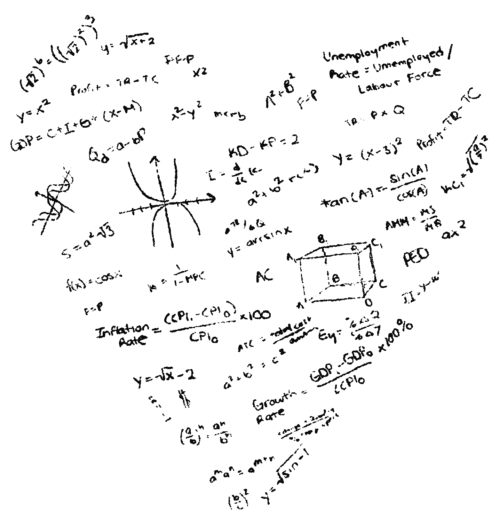
On my way back from my Econometrics section, a classmate told me that a good approach to women is to pick the one that minimizes costs and maximizes utility. In plain language: pick the woman who gives you the most while you give the least.
I thought of Arabic music, specifically Umm Kulthum, the Egyptian singer called Kawkab al-Sharq, the Planet of the East, whose hour-long songs taught the Arab world what love sounds like. In the world I grew up in, love was never chosen like that. It arrived totally, excessively, nearly impossible to optimize.
The same culture that produced Umm Kulthum’s songs of boundless love also produced Adel Emam, Egypt’s most beloved comedian, who became something of a prophet. For six decades, his films and plays staged love against the machinery of modern life: bureaucracy, poverty, and politics squeezing the romance out of ordinary people. He played it for laughs, until the laughs started sounding like a diagnosis.
“العواطف ستكون آلية.” Emotions will become mechanical.
Adel Emam said this when an interviewer asked him to predict life after 2000. Walking home from section, I started to believe Emam: our emotions were becoming mechanical, maybe even mere calculations.
I am an economics and a neuroscience student at Harvard, but I am also pursuing acting. I fell in love with the craft largely because of Egyptian cinema, a universe where emotions are never treated as data points, but as sweeping, tectonic, astronomical shifts.
To the actress in me, it sounded like an obituary. To the economist, like a progress report.
That is the friction, stripped down. It is not just about facing a discipline like economics. It is mainly about facing people who think like that, economically, mechanically, almost robotically, in ordinary life. People who talk about love as a trade, who weigh what a person gives against what a person costs, who want the maximum return for the minimum input. A mind raised on stories runs straight into that. In that upbringing, meaning keeps expanding; feeling is treated as information, even without permanence. The mechanical mind cuts almost all of that away. The clash isn’t a failure of logic, and the alienation that follows isn’t a cognitive deficit. It is a cognitive mismatch, a completely different set of defaults about what counts, what matters, and what a person is actually worth. One side reads intensity as meaning. The other reads it as inefficiency.
Consider the cognitive training of a Middle Eastern household. From childhood, you are immersed in a moral and emotional landscape that privileges narrative expansion. Events are rarely treated as isolated or finite; they are swept up into grand moral arcs, communal obligations, and deep symbolic weight. (This is not a claim that Middle Easterners are inherently “more emotional”; it describes a training environment that varies, like any.) For an actor, this is incredibly fertile soil. Through experience-dependent plasticity, the brain learns to treat affective cues as high-value signals. We are trained to lean into the moment’s poetry, to amplify the signal.
But economics demands that you flirt with a very different kind of muse: abstraction.
Music best savors the contrast. Take the German pop song by Revolverheld, “Ich lass für dich das Licht an.” The title means, “I will leave the light on for you.” In the song, love sounds like this: “I leave the light turned on for you, even though it is too bright for me.” It is practical, reliable, and deeply efficient. A small sacrifice, clearly stated.
Now turn on “Enta Omri,” Umm Kulthum’s most famous love song, first released in 1964. The title means “You Are My Life,” and the song is a nearly hour-long declaration of love. In one of its best-known lyrics, translated from Arabic, she sings: “You are my life; with your light its dawn begins.” This is not a transaction. It is a total, intoxicating, and unbounded reorganization of the self. She does not sing one feeling for three minutes. She stretches it for an hour, repeating it until it becomes your whole world.
When a mind habituated to the scale of Enta Omri meets someone whose training, explicit or implicit, taught them to treat human connection economically, the resulting friction is almost seductive in its complexity. Behavioral economics tries to account for this through “salience bias,” noting that humans foolishly overweigh emotionally vivid or symbolically meaningful outcomes. But framing an emotionally rich worldview as a “bias” or “heuristic error” misses the point. It is a model specification error. Models treat as noise what our minds experience as the actual signal.
Mechanistically, neuroscience shows we never assign value purely logically. Emotion and reasoning work in tandem, and a childhood immersed in emotionally charged stories trains the brain to treat feeling intensity as meaningful information. When we sit in a room and force ourselves to optimize within constraints, we are not failing to compute. We pay a real mental and physical price for forcing our deepest valuation system into hibernation.
Ultimately, the challenge isn’t to “correct” our emotional minds to make them more compliant for the market, even if mitigating these mismatches might reduce the acute stress that occurs when our core valuation systems are forced into a deep freeze. The real question is whether the disciplines that govern human systems are rich enough to account for the way humans actually assign value.
Something profoundly Kafkaesque about the modern distribution of these cognitive styles: we have built an academic and economic world where some people may optimize flawlessly but live in emotional compression, never experiencing the unbounded depth of an Enta Omri existence.
Conversely, others feel so deeply that the cold language of optimization feels entirely alien. While it is arguably easier to teach a deeply feeling mind how to optimize, capturing that rare capacity to feel profoundly is a far more elusive, complicated, and delicate human art. And if you have to optimize one of the greatest human emotions, you’ve already lost it. What remains isn’t love; it’s accounting. Congratulations! You are an accountant.
If Adel Emam is right and our emotions are doomed to become mechanical, then holding onto our narrative depth may be the ultimate act of defiance. The future of economic modeling may depend less on successfully suppressing the drama of human meaning than on finally giving it a role.
Tibah Abid ’28 (tibahabid@college.harvard.edu) is a writer for the “Harvard Independent.”