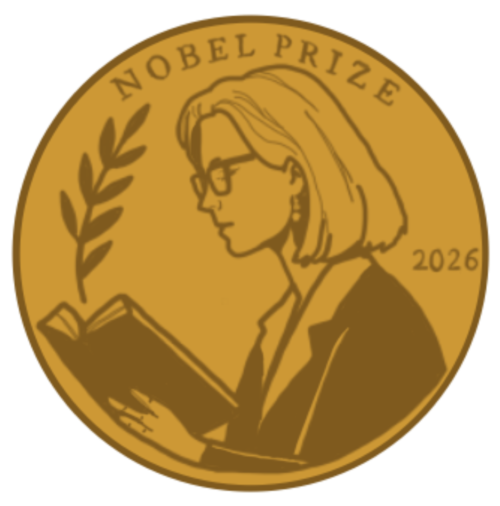
Why Anne Carson Won the 2026 Nobel Prize in Literature
Graphic by Ella Cohen

On Oct. 8, the 2026 Nobel Prize in Literature was announced, and classicists around the world celebrated: Anne Carson—acclaimed poet and translator of many Ancient Greek works—had won at last. Although I root for Haruki Murakami every year like a middle-aged father cheering on his favorite football team (next year I swear Murakami is going to win it all!), I do think Carson was a fantastic choice.
The Nobel committee stated that Anne Carson received the award for “her bold and inventive oeuvre that, in playful dialogue with the classical tradition, has created new forms for contemporary literature.” But what exactly does that mean?
One of Carson’s most famous literary works is “The Glass Essay,” a long-form lyric poem that blends a personal narrative of heartbreak with critical commentary on Emily Brontë. Carson intertwines a constructed narrative of a devastating breakup with Emily Brontë’s oeuvre and life. In doing so, Carson incorporates critical analyses of Brontë’s life and observations from her sister, Charlotte, to comment on heartbreak, isolation, and literature as an emotional outlet.
“The Glass Essay” begins with the speaker lying awake at 4 a.m., thinking of her past relationship with a man named “Law.” She contrasts the sexual nudity sought by Law with the “naked glimpses of [her] soul,” 13 images which she calls “Nudes.” This emphasis on what it means to be naked appears even in the poem’s title, “The Glass Essay,” as readers view the speaker as if through a piece of glass: completely bare and unfiltered.
Brontë is intertwined with the speaker’s grief in a way that at first seems out of place—how does this author from the 19th century relate to the speaker’s breakup? Eventually, readers understand that the speaker identifies with Brontë, feeling that her liminality and isolation after being abandoned are turning her into Emily Brontë. At the end of the poem’s second section, “SHE,” the speaker asks: “What meat is it, Emily, that we need?”
The speaker does not just allude to Brontë as a kindred spirit, however. The poem’s unique perspective—what the Nobel committee calls “bold” and “inventive”—comes from Carson’s combination of this intensely personal narrative with literary analysis. The speaker quotes unnamed critics (likely inventions by Carson to represent a general argument within the literary world rather than any one scholar), using interpretations of Brontë and her life to deepen her self-understanding or refute a claim with her own experience. In one stanza, a disparaging critic wonders why Brontë longed for liberty when her home life was satisfactory. The speaker responds that imprisonment takes many forms and describes her own childhood, showing how she reads Brontë’s poetry through her own life.
Despite the beauty and innovation within “The Glass Essay,” my personal favorite work by Carson is her translation of Sappho’s lyric poetry, which she titled “If Not, Winter: Fragments of Sappho.” Only one of Sappho’s poems was long known in full, but Carson translates every known fragment, using white space and brackets to show the gaps in the manuscripts, or lacunae, in each poem. This emphasizes the lost parts of Sappho’s poetry, allowing readers to fill in the gaps themselves.
The reception of “If Not, Winter” was resoundingly positive—a feat in itself, especially for a translation of Classical texts. “This method imitates the tattered reality of the Greek texts of Sappho, yet gives free rein to the translator’s and reader’s imagination at the same time,” said classicist Emily Greenwood, a professor of Classics and comparative literature at Harvard University.
I feel that this description encapsulates Carson’s masterful translation: what is left unsaid gives readers agency. This also invites “new forms for contemporary literature,” as the Nobel committee states. Although Carson’s work with the classical tradition forced her to translate around these gaps, future poets may choose to leave them intentionally, compelling readers to fill them in with their own experiences and fostering different interpretations of the text.
The work’s title comes from “Fragment 22,” a short, sparse lyric poem that describes yearning for someone unobtainable. The fragment ends with the lines, “In fact she herself once blamed me / Kyprogeneia / because I prayed / this word: / I want.” Even Aphrodite (often called Kyprogeneia, or Cyprus-born) frowns on the speaker’s longing. Love itself reproves something as supposedly pure as love. This illustrates the friction against social norms that Sappho frequently grapples with, whether that be because of her speculated homosexuality or openness with erotic desire. Although the poem is incomplete, the raw emotion it conveys transcends time and, thanks to Anne Carson’s translation, language.
Some of the most powerful fragments are only a few lines. Although these phrases were undoubtedly part of larger poems, the short, incomplete statements suggest that Sappho tried to capture a torrent of emotions through fleeting, unfinished vignettes. A few of my favorite examples are as follows: “you burn me” (Fragment 38), “you came and I was crazy for you / and you cooled my mind that burned with longing” (Fragment 48), “I don’t know what to do / two states of mind in me” (Fragment 51), “do I still yearn for my virginity?” (Fragment 107), and “someone will remember us / I say / even in another time” (Fragment 147). Carson’s bold choice to give these brief fragments their own pages highlights what Sappho’s poetry has lost.
Anne Carson has many other works that demonstrate the mastery that won her the Nobel Prize, but these two, I believe, represent her range.
Her ability to innovate within a field that has existed for thousands of years while still paying homage to its origins amazes me, and I am delighted she won the Nobel Prize. Of course, the beauty of Carson’s poetry is that everyone may experience it differently, so I encourage you to explore her “bold and inventive oeuvre” for yourself.
Eden Bridge-Hayes ’29 (edenbridgehayes@college.harvard.edu) just added Anne Carson’s verse novel, “Autobiography of Red,” to her reading list.