A Playlist for the RevolutionaryNine political songs to add to your library.
Graphic by Annabella Burton

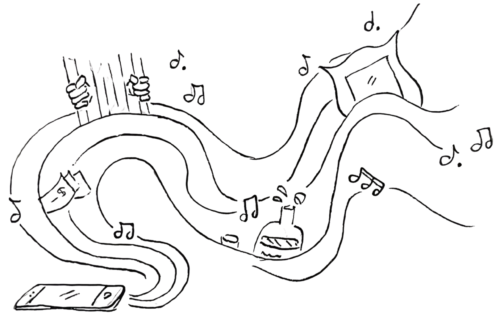
Across cultures and time, throughout wars and revolutions, one thing has remained consistent: when oppressed peoples cannot speak, they sing. Protest music has unified movements of all kinds, whether it comes in the form of soft folk or hard rock. If you are feeling especially revolutionary after the Nov. 3 election, want to learn more about political music, or just want to add some songs to your playlist, give these tracks a listen.
“Drink Before The War” (1987) by Sinéad O’Connor
O’Connor was only 19 when she first recorded this song as an exploration of memory, violence, substance abuse, and coming-of-age during The Troubles in Northern Ireland. The chorus repeatedly references a man outside of a liquor store who yells, “Anybody want a drink before the war?” The image reflects the rampant alcoholism plaguing Ireland at the time and its role as an anesthetic in the face of large systems of violence. In her verses, she condemns the wealthy’s complacency in the face of the poor’s suffering, writing, “You got a nice big car, nothing bothers you / Somebody cut out your eyes, you refuse to see.”
Though “Drink Before the War” is one of her most famous works, O’Connor said she hated it 10 years after the song’s release. “When you’re fifteen you think you’re being really deep and meaningful, and actually you’re talking a lot of bullocks,” she said.
“The Message” (1982) by Grandmaster Flash & The Furious Five
One of the most influential hip hop tracks ever, “The Message” put politically conscious rap on the map. Since its release in the early 80s, the song has become one of the most sampled rap songs in history, incorporated into tracks by Ice Cube, Coi Leray, and Lin-Manuel Miranda, to name only a few. The song breaks down the living conditions of the New York ghetto and the school-to-prison pipeline. “It was the first dominant rap group with the most dominant MC saying something that meant something,” Public Enemy’s Chuck D said, a group best known for their work on the soundtrack of Spike Lee’s classic Brooklyn film “Do the Right Thing.”
“Folsom Prison Blues” (1955) by Johnny Cash
Johnny Cash first wrote this famous country song while stationed in Germany, where he first watched Crane Wilbur’s crime drama “Inside the Walls of Folsom Prison.” The song tells of the laments of a fictional prisoner who is serving life in the California prison after gunning a man down in Reno. The song humanizes prisoners and connects crimes to economic hardship at a time when advocating for prisoner rights was rare. Cash recorded the song live inside Folsom Prison in 1968, a performance so revolutionary that he was asked to perform at state penitentiaries across the country. There, he heard firsthand accounts of the abuse suffered by the incarcerated, inspiring his advocacy for prison reform later in his life.
“Whitey On The Moon” (1970) by Gil Scott-Heron
Known for his lyrical poetry and Afro-inflected beats, Gil Scott-Heron released this short song just months after the U.S. won the Space Race and put man on the moon. The poem paints a picture of the poor living conditions of many Black Americans, who faced high rent prices and severe medical debt while working lower-paying jobs. With every description of his economic hardship, he reminds listeners that “whitey’s on the moon,” highlighting the government’s ability to fund space exploration while refusing to provide necessities to its civilians.
Though Scott-Heron released the song half a century ago, it remains as relevant as ever: Artemis II completed its orbit around the moon this summer. At the same time, rent and medical prices continue to skyrocket in urban areas.
“Money, Money” (1966) by John Kander and Fred Ebb
No playlist is complete without a musical number, and no account of political music is complete without “Cabaret.” The musical follows regulars at Berlin’s Kit Kat Club during the collapse of Germany’s Weimar Republic and the consequent Nazi takeover. The musical warns against distractions from political dangers, portraying such fun-loving characters who believe themselves separate from their rapidly changing, radicalizing political world. This satirical number, a vaudeville performance about financial survival, points to the connection between economic instability and susceptibility to fascism.
“When you go to get a word of advice
From the fat little pastor
He will tell you to love evermore
But when hunger comes to rap
Rat-a-tat, rat-a-tat at the window (at the window!)
Who’s there? (hunger) Oh, hunger!
See how love flies out the door.”
While several amazing renditions exist, I personally recommend Alan Cumming’s 1998 recording.
“Burka Blue” (2005) by Burka Band
Afghanistan’s first all-female band was a completely anonymous rock group formed by three women in Kabul. The blue burqa, also known as the “shuttlecock,” differs from the black burqa because it fully anonymizes the wearer. While the black burqa is made of three pieces, leaving some room for the wearer’s eyes, the blue burqa is a single cloth that completely covers the body and identity. Forced upon women by the Afghan Taliban regime, the burqa continues to be one of the most controversial garments in the world. The band members, who wear the oppressive material as a symbol of resistance, point out the dangers of the garment:
“You give me all your love
You give me all your kisses
And then you touch my burqa
And do not know who is it.”
“Killing in the Name” (1992) by Rage Against the Machine
Definitely the most hardcore song on this list, “Killing in the Name” emerged in response to the infamously brutal beating of Black civilian Rodney King by Los Angeles police officers in 1991. Though the song is over five minutes long, it repeats the same six lines, including the two below.
“Some of those who work forces
are the same that burn crosses”
These lyrics point to the violent racism latent in city police forces at the time. But, in keeping with the band’s name, the song refuses to quietly accept systemic injustices, crescendoing with the line, “Fuck you, I won’t do what you tell me,” repeated 16 times.
The outrage of the song even seeps into its album cover, a famous photograph of Buddhist Monk Thích Quảng Đức self-immolating at a Saigon intersection in protest of Vietnam’s persecution of Buddhists.
“Sound of da Police” (1993) by KRS-One
With its catchy chorus and drum beat, this song has developed into a popular club track and sports arena anthem. But its origins aren’t that of your average dance-rap song: released at the height of the War on Drugs, “Sound of da Police” delivers a scathing protest against the New York Police Department. By imitating the sound of police sirens and describing the fear and anger felt at their arrival, KRS-One points out the extreme aggression Black New Yorkers faced, and the necessary violence criminalized groups respond with. Most famously, the song draws parallels between police officers and plantation overseers, both of whom act as the executors of higher authority.
“The overseer had the right to get ill
And if you fought back the overseer had the right to kill
The officer, he has the right to arrest
And if you fight back, they put a hole in your chest.”
“Man in the Mirror” (1988) by Michael Jackson
“Man in the Mirror” encourages listeners who want to see positive change in their societies first to look inward and improve themselves. In today’s socially and politically divided world, it’s easy to look at other groups and demand they change. This song is a persistent and necessary reminder that the first and most important place to begin a revolution is within oneself.
While many of these tracks are lyrically beautiful and catchy, none of them can be limited to their musical value alone. These songs have motivated freedom fighters, comforted the disenfranchised, and educated the public. Listening to any of them can help one notice the flaws in their own society and appreciate the changes these artists fought for.
Nuala Mernin ’29 (nmernin@college.harvard.edu) made a Spotify playlist featuring all of these songs.
https://open.spotify.com/playlist/1KYI4ADfB1sdgtiVpyN6cF?si=YStnDS-wQVygUmVCGJFUdQ.