BerryLINE
Graphic by Kerrie Zhu

In 1989, the year my sister was born, my dad bought our family home in rural Appalachia in upstate New York, where he now lives. Standing in an overgrown forest, the 200-year-old house is an artifact in itself, largely untouched by modern renovation.
The whole village mirrors this timelessness—my dad’s favorite example is Baird’s Tavern, a pit stop on George Washington’s march across the Northeast where he purchased a round of grog (a Revolution-era beverage consisting of water-diluted rum, according to the “Drunkard’s Almanac”). Bellvale Farms, resting atop a nearby hill, has a similarly rich history beginning with its founding in the early 19th century. In 2003, the farm opened its creamery, a family favorite and a coveted spot on Appalachian Trail maps for backpackers who have made the journey up from Georgia (my dad has picked up a number of these hitchhikers at the creamery), not to mention the cows grazing just down the hill, ensuring product quality.
This is all to say that the house, the village, and the farm have long existed outside my New York City milieu, and they have always been a haven away from the crowds and excess.
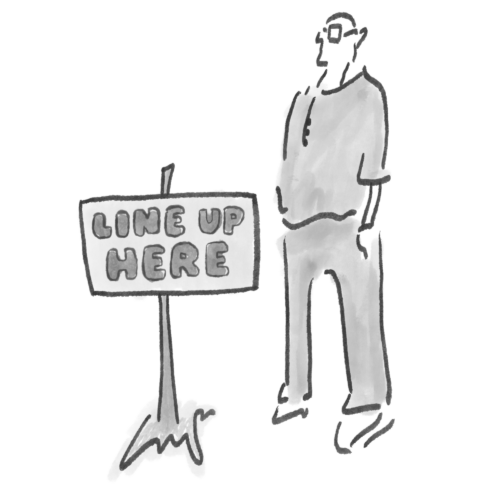
This summer, I visited my dad, and we decided, in the spirit of old times, to visit Bellvale Creamery. The site had already expanded significantly in recent years to accommodate its growing number of visitors. But what we came upon was different. A packed parking lot, a line snaking through stanchion dividers, a big sign obstructing the beautiful view of the valley. We decided to wait in line, like a TSA checkpoint at JFK International Airport on Thanksgiving.
While the ice cream, fresh from the cow, never disappoints, the novelty of what had for so long felt like a mom-and-pop shop had dissipated.
Prolific marketing and influencer culture play a central role in the proliferation of line culture. Take Harvard Square’s very own BerryLine, which these days has really lived up to its name, minus the “berry.” Even in the two years I have been at Harvard, it has transformed from a local gem into Cambridge’s “hardest club to get into.”
Meanwhile, in NYC, frozen yogurt joints have been popping up on nearly every corner. Walking through Chelsea, the West Village, SoHo, or the Upper East Side, I’ve found it’s become a task just to avoid the lines snaking for blocks, all because of a storefront smaller than my New Quincy single. And don’t get me wrong, I love a good froyo on a no-line day (a 10 out of 10 is Glace Greek froyo with whipped honey), but it only seems possible to get it during the off-hours of a rainy day in the middle of the week. Between Myka, Birdie’s, Mimi’s, Madison Faire, Culture, Go Greek, and others I am surely forgetting, froyo is slowly hijacking the corner real estate of NYC.
As a vehement opponent of line culture—with the exception of the occasional Bellvale Creamery—I can’t imagine what would compel someone to wait an hour in the brutal humidity of a mid-summer New York day for 10 minutes of satisfaction. Paradoxically, though, I can’t help but be enticed by a product so transformative that it is worth the wait. That momentary curiosity, combined with exposure from social media influencers and health culture, makes the line culture at these destinations so effective.
Each location offers a slight variation on an essentially identical product—Myka’s “mykataifi,” Madison Faire’s whipped honey, etc.—and has effectively marketed its line to build curiosity and demand. This combination of carefully curated variations and intense business competition—neighboring Myka and Birdie’s have taken over 7th Avenue between Charles and Perry—seems to turn line-waiting into an activity, adding to our already prolific materialism and social media’s takeover of the third space.
Even in a world of dwindling patience and attention spans, queue culture has an obvious psychology behind it; a 2015 behavioral study, “The Positive Role of Queues on Customer Value Perception,” examines a myriad of factors, most notably perceived value and mimetic desire. When we see that other people think a product is worth waiting for, we want to experience it too. Moreover, for those with the luxury of waiting, the visual aesthetic of the entire experience (the line, the service, the product) fits perfectly into a 30-second review reel.
The efficacy of such curated experiences and their resulting cultural impact is reflected in the industry’s growing market power. In the 2010s, Pinkberry, 16 Handles, and Red Mango, the OGs of the first froyo boom, were backed by private equity from the onset. The new crop is playing the same game: Myka just landed a growth equity investment to fund its “mykataifi” monopoly. The frozen yogurt market is projected to nearly double by 2035, from $6.6 billion to $11.53 billion, riding the same wave of nutrition-obsessed, startup-brained culture that put us all in line in the first place.
And while many things in life are worth the wait, I can’t imagine I’ll be grateful on my deathbed for the hours lost waiting for trending froyo. But even amidst the hundreds of influencers hopping on the review train, some still go against the grain. Take @mattpeterson, who proudly boasts a 22-day series “boycotting lines in NYC.” In this series, which has amassed hundreds of thousands of views, Peterson exclusively dines at no-line, family-owned businesses, many of which have suffered the consequences of the herd mentality behind business-stealing line culture.
Again, sometimes the line is worth the wait—the “Bellvale Bog” (a chocolate fudgy brownie flavor) will always draw a queue. What counts is the recognition of product value over herd mentality—not standing in line just because it’s there, but asking yourself if a full afternoon in New York is well-spent waiting an hour and a half for four ounces of froyo at $15. Trying new businesses and products is to be expected, but it may be worth considering how to do so without validating excessive consumerism. Though I mourn the days of BerryLine and Madison Faire before they became mainstream, perhaps a greater appreciation of time will inspire me to further explore underground, less-influenced businesses instead.
Mia Wilcox ’28 (mwilcox@college.harvard.edu) is the Forum Editor of the “Harvard Independent.”