My Neighbor, Dolly
Graphic by Seyi Amosun

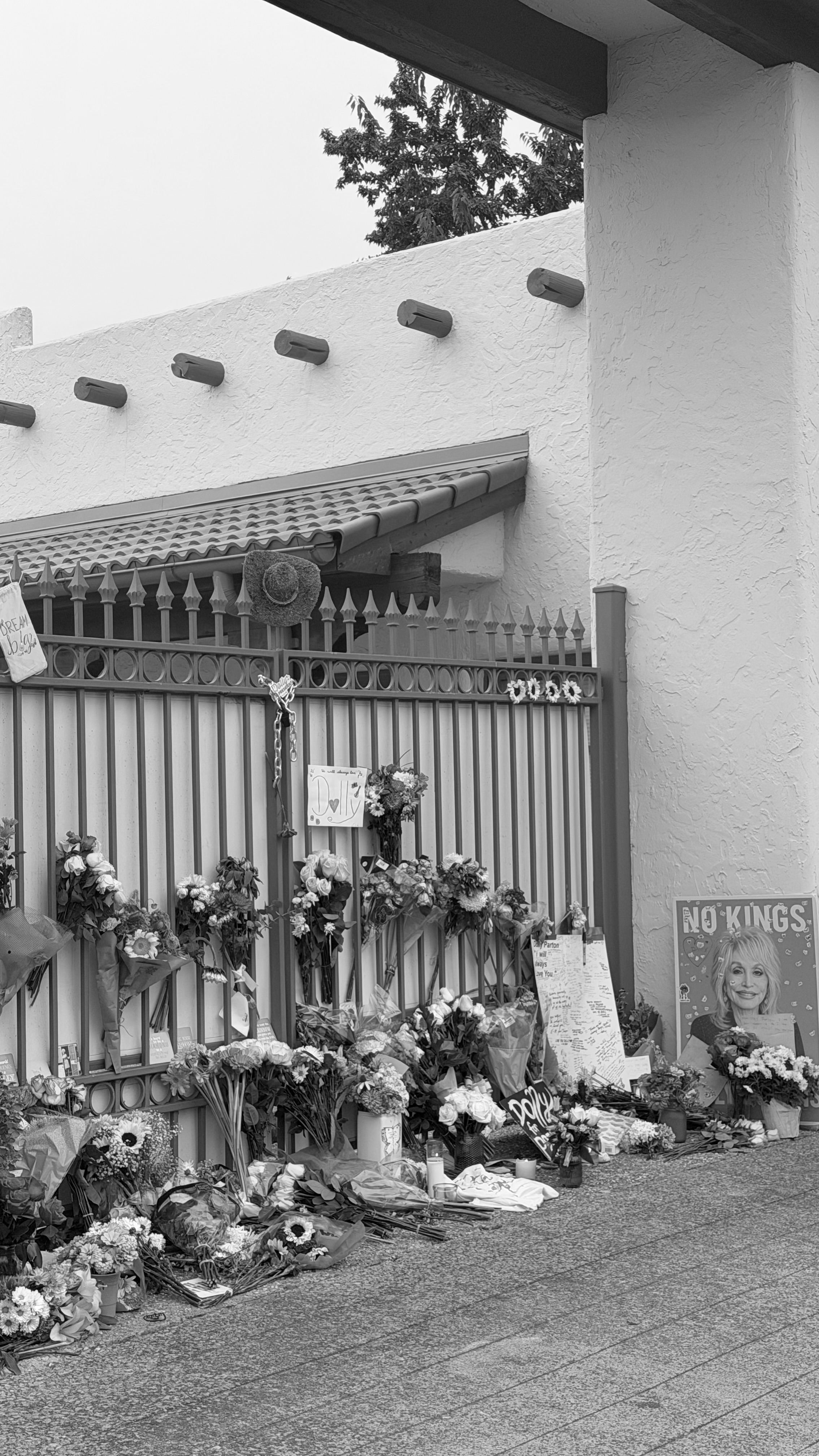
Driving around my hometown of Brentwood, Tennessee, I would always crane my neck to see if butterflies were affixed to the gate of 9510 Crockett Road. Only seven minutes away from my childhood home, the red-and-white mansion was barely visible from the street. But when the butterflies were there, we knew something important: Dolly Parton was home.
Growing up in a medium-sized suburb right outside of Nashville, I cannot claim much besides an inculcated enthusiasm for high school football and a staunch belief that Southern food is superior to all else. But after the tragic passing of Dolly Parton just weeks ago, I have been reminded that my Southern roots should be a source of dignity, inspiration, and drive to be more like her.
After seeing the whole country (and world) come together to celebrate her life, I cannot help but feel a sense of pride in this new—or renewed—love for someone with whom I share my heritage. To most Tennesseans, Dolly was not just another singer or celebrity whom we loved. She was a philanthropist, a neighbor, a friend. Her legacy is woven into my life in ways I haven’t taken time to reflect on, but I want to now, as I honor her memory.
· · ·
I have vivid early childhood memories of running home from the bus stop and excitedly opening the mailbox at the beginning of the month. I developed a love for checking the mail—and though I definitely sought out the American Girl monthly magazines and Tinker Crate craft boxes, I particularly loved receiving brand-new books from the Dolly Parton Imagination Library.
In a state that ranks 31st for education and is plagued by the ongoing literacy crisis, the Imagination Library has made an immeasurable effort to help children in Tennessee, across the United States, and around the world. The program has delivered 332,411,218 (and counting) books completely free of charge. Started in Sevierville (seh-veer-vulle, not “ville”), Tennessee, in 1995, the Imagination Library began as Dolly’s way of giving back to her hometown. It has since massively expanded, with more than 1 million books delivered by 2003.
In the early ’90s, she pledged to donate $500 to every seventh- and eighth-grader in the county if they and a buddy both graduated high school. This “Buddy Program” effectively cut dropout rates from 35% to 6%.
Though I may sometimes disagree with the decisions made by my state legislature, Tennessee secured full library coverage in 2004 and recently announced plans to pursue full funding for the project next year. Dolly was one of the very few individuals with a legacy that looms so large. Her singular initiative has helped so many children who call Tennessee home. The program helped me develop a love for reading and literature; it is surely a reason I can write for this publication as a Harvard student today.
· · ·
I will be completely honest—I did not know Dolly Parton wrote “I Will Always Love You.” I had always associated it with Whitney Houston. Though many likely consider the latter’s rendition of the song to be far more famous, that never stopped Dolly from using her talent for good.
Houston’s version of the song eventually topped the charts, earning a Grammy Award for Record of the Year in 1994. Dolly Parton eventually made over $10 million in royalties during the ’90s.
The money was rightfully hers, but I will forever admire Dolly’s penchant for sharing the wealth and spreading the love. Instead of opting for an office on Nashville’s Music Row, home to some of the biggest country music stars, she invested some of the song’s proceeds into an office complex in 12 South, a neighborhood in South Nashville. The predominantly Black neighborhood, formerly home to a strip mall, was revitalized after her investment.
She specifically chose the area as a tribute to Whitney, calling it “the house that Whitney built.”
· · ·
I have spent more time than most at Monroe Carell Jr. Children’s Hospital at Vanderbilt University Medical Center. Growing up with a sibling who has sickle cell anemia, I have always been grateful for the staff and donors to the hospital. Unsurprisingly, this list includes our favorite philanthropist, Dolly Parton.
During the COVID-19 pandemic, Dolly made a massive $1 million donation to Vanderbilt’s vaccine development program with Moderna. She also used her fame and household-name status to encourage others to get vaccinated. The CEO of Vanderbilt Health, Jeff Balser, touted her contributions that have helped thousands: “Dolly was a global icon and a friend of Vanderbilt. Her amazing generosity, particularly in pediatric cancer and infectious disease research, has had a transformational impact on patient care and treatment,” he said.
In my book, there is no greater gift than good health. And I will truly be grateful to Dolly for influencing the masses to get vaccinated to the tune of her hit song, “Jolene”: “Vaccine, vaccine, vaccine, vaccine, I’m begging of you, please don’t hesitate.”
· · ·
Dolly has quite clearly shown us a lot of love in Nashville and Tennessee as a whole. In turn, we are doing our best to show her the same love. The state has announced plans to rename Nashville International Airport in Dolly Parton’s name as an enduring tribute to her.
At the American Legion Auxiliary Volunteer Girls State in Tennessee, delegates are randomly assigned to one of 14 “cities,” each with a team of counselors, for the week. I attended the program in 2024, and by then, organizers had already venerated her by naming one of the cities in her honor: Parton City. I expect countless other institutions in Tennessee, including libraries, schools, and clinics, to bear the name of one of America’s greatest heroes.
Tennessee will not be the same without Dolly. The world will not be the same without Dolly. But as I remember the pink lights that illuminated the houses in neighborhoods back home after she passed, I still feel hope that her memory can continue to unify us in community, just as she did.
Seyi Amosun ’29 (samosun@college.harvard.edu) is proud to call Nashville home.