The Dirty Word… Liberalism
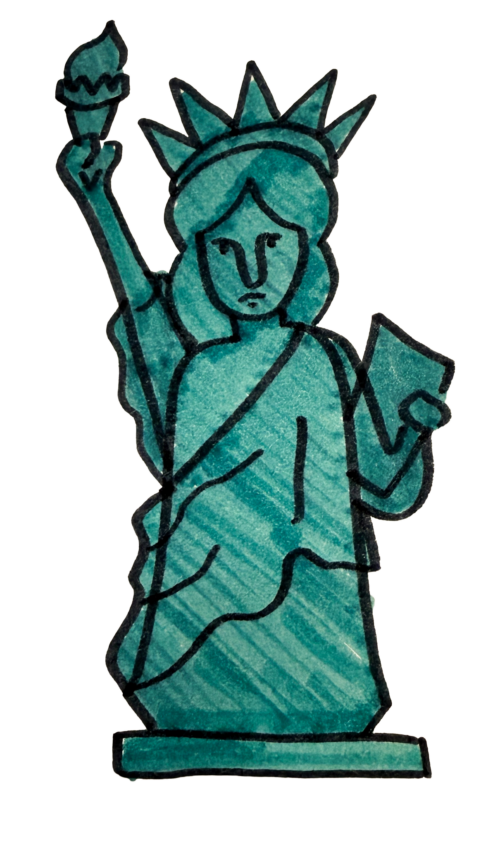
Graphic by Cameron Bernier

Last semester, I authored an opinion editorial titled “A Commentary on Conservatism,” in which I, borrowing the words of Sir Roger Scruton, described the ideology as a “philosophy of love.” This is a sentiment I still hold to be true. The title of a “philosophy of love” doesn’t solely belong to conservatism but is a moniker which I think applies equally to its ideological adversary, liberalism.
If we take conservatism, in simple terms, to be a love of what was and a reverence for tradition, then we must be able to understand liberalism as a love of what could be and a reverence for the ideals of man. However, as history has shown, we have failed to live up to the lofty ideals the philosophy demands.
Take, for example, the preamble of the Declaration of Independence—an inherently liberal document rooted in Enlightenment-era ideals. “We hold these truths to be self-evident, that all men are created equal, that they are endowed by their Creator with certain unalienable Rights, that among these are Life, Liberty, and the pursuit of Happiness.” There is a painful hypocrisy within these stated goals, given that 48 of the 56 signatories of the Declaration of Independence directly profited from slavery. Nevertheless, it is the document’s ideals that we should look to rather than their application, or lack thereof.
The term “liberal,” especially in today’s intensely polarized political climate, has become weaponized as an insult. Its original meaning has become lost behind clickbait headlines and partisan soundbites, reducing a centuries-old philosophy to nothing more than a political brand. However, if being a liberal means being “someone who looks ahead and not behind, someone who welcomes new ideas without rigid reactions, someone who cares about the welfare of the people,” as John F. Kennedy put it, then I am proud to say that I too am a liberal.
I don’t think this is a partisan statement, and if it is, it just shows how far politics has divided us. Leading with care and compassion for others and striving for equality are not political issues but should be fundamental to the American way of life. Emma Lazarus’s poem, “The New Colossus,” which is mounted on a plaque within the Statue of Liberty, speaks to the values that aren’t just liberal but inherently American. “Give me your tired, your poor, / Your huddled masses yearning to breathe free, / The wretched refuse of your teeming shore. / Send these, the homeless, tempest-tost to me, / I lift my lamp beside the golden door,” it reads. These words point to the liberating vision of what America is supposed to be, yet the light of the “golden door” seems to be dimming more and more as the years go on.
Here lies the issue: we’ve enshrined beliefs and deified the American way of life but abandoned the principles in practice. The Statue of Liberty stands as a monument to the promise of America, yet we now debate which of the tired and poor are worthy of sharing in our prosperity. At our nation’s founding, we declared all men equal, but two hundred and fifty years later, equality remains unrealized for many. We celebrate JFK’s vision of a free and fair society, yet our institutions no longer know how to practice it and, in some cases, have entirely forgotten what the words “free and fair” mean.
“I will lift up mine eyes unto the hills, from whence cometh my help,” says Psalm 121:1. On the 250th anniversary of this great nation, I have looked to the Hill, the institutions that we hold so dear, the documents upon which the country was built, and have seen no help coming. Benjamin Franklin, in a letter to his close friend Joseph Priestley, mourned that he would not live to see what the world, and by extension America, would be like in 1,000 years. With our current trajectories, I have some doubts that we will see a 500th anniversary, let alone a 1,000-year one. But all is not lost.
Americans have always found a way. I’m not talking about the people in politics, who more often than not parrot talking points aimed at separating us rather than bringing us together, but the average citizen who knows right from wrong and good from evil. The American who helps their neighbor not for personal gain but because it’s the right thing to do, who gives back and seeks to leave a better community for the next generation to inherit. The American who cares about their fellow man not out of political calculation or ideological obligation but simply because they are American and that means something; it means caring for the stranger, the tired, and the poor; it means remembering that our ideals, however marred by our failures, still mean something to us 250 years later.
Perhaps I am blinded by a sense of patriotism and a belief in people over politics, but I would rather be wrong about humanity than right about despondency. I love my country not for what it was but for what it has overcome and continues to strive to be. “To be conservative, then, is to prefer the familiar to the unknown, to prefer the tried to the untried […] the convenient to the perfect, present laughter to utopian bliss.” These are the words of Michael Oakeshott, a prominent British conservative philosopher, in his 1956 essay “On Being Conservative.” Though I understand and empathize with his statement, sometimes the tried is not true, and we must go further into the unknown in pursuit of the noble aims that our founding fathers set before us some 250 years ago. If a convenient society is built on drastically unequal grounds, then that convenience is an illusion that we have fed ourselves to justify abandoning our foundational principles.
One can exist as a conservative and a liberal at the same time because fairness and wisdom are not opposing forces. They work hand in hand, dancing around each other like awkward teenagers at the high school prom—sometimes they step on each other’s toes, but eventually they find rhythm. I believe in respect for the tried and tested, the institutions that have stood the test of time, and prefer the gradual to the revolutionary; however, I am also cognizant that tradition can lead, and has led, to the calcification of injustice. In short, the way things were, or are, does not have to be the way things must be.
I can dance with both philosophies because fairness is not utopia. Dignity, equality, the removal of barriers, and real opportunity for all are not radical dreams but the bare minimum. I want what’s right, not perfect, so I’ll dance with both even when my feet hurt because the alternative—giving up on fairness or wisdom—is not a concession I am prepared to make, and neither should you.
Happy Birthday, America, and may the next 250 years be better than the last.
Noah Basden ’29 (nhbasden@college.harvard.edu) wants to warn prefrosh not to lick John Harvard’s left foot.