A History of Comics
Graphic by Miranda Chao Hwang

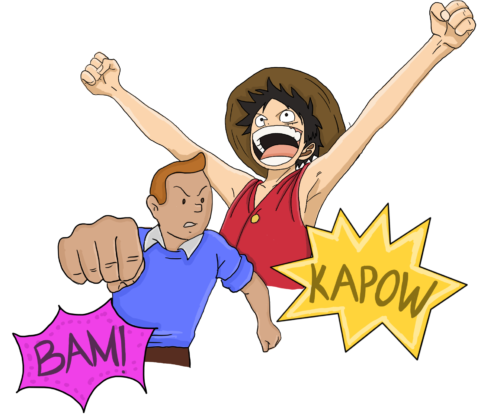
To probably no one’s surprise, I was a massive bookworm growing up. I credit my parents with taking me to the library every weekend and patiently listening when I read books aloud to them.
They also gave me a love for comics. Alongside traditional novels, I read the pre-teen series “Percy Jackson,” “The Adventures of Tintin,” and Japanese manga. I remember my dad buying “The New Yorker Encyclopedia of Cartoons,” two heavy tomes I spent hours paging through, wondering when I would finally understand the jokes I didn’t get yet.
My enthusiasm for comics is far from unique; many aficionados are far more dedicated to collecting and discussing comic books. “Tintin” has had relatively low popularity in the United States, so I never had much reason—or company—to expand beyond rereading my favorite issues.
At my local library, kids would always swarm to check out classic graphic novels like “Big Nate” or “The Baby-Sitters Club.” This often disappointed my elementary school teachers, who chastised my classmates for reading graphic novels during silent reading time and said it didn’t count as “actual reading.” Reading comics is seemingly more fun and accessible to readers of all ages. This connotation—purely for entertainment, lacking serious content save for the occasional wry societal observation here and there—stems from the genre’s history.
***
The first large-scale combination of pictures and words was—unsurprisingly for the Western world—the Bible. In the 1830s, London mass-printed “The Pictorial Bible.” Though illustrated Bibles had existed since the 15th century, none were as thorough as this version, which featured a picture accompanying almost every major scene; the number of illustrations leaped from around 30 to hundreds. Woodblock carvings, which required a huge initial investment in artists, accompanied biblical verses, but advances in printing technology let printers reproduce them quickly.
The goal of such a labor-intensive yet inexpensive Bible was to reach the largely illiterate masses of the time. Though literacy increased significantly in the next hundred years, only about half of England could read at the end of the 19th century. Even for literate Christians, a widely distributed pictorial Bible would have solidified iconography, characters, and settings in the common imagination.
Though the concept of a “comic” had not been invented yet, this biblical form foreshadows the reasons comics and graphic novels became so popular and pervasive as storytelling methods. They not only help readers understand a work’s core scenes and themes but also create cohesive interpretations. In turn, this makes discussion smoother (though not necessarily broader), allowing tight-knit communities to form around the same story.
The power of visual cues is often underestimated, but the effects are lasting—for example, after watching a movie adaptation of a book, one automatically starts envisioning the associated actor’s face when returning to the text.
The next step in the comic’s evolution is much more familiar to the modern reader: the political cartoon. With Enlightenment ideals of free speech and new engraving methods, artists began combining text and imagery to satirize and comment on society. Political cartoons emerged in Britain in the 1720s, but they caught fire in Britain’s American colonies during a time when everyone wanted to criticize everything—the American Revolution.
American students should be familiar with these satirical cartoons in their history textbooks: “Join, or Die,” Benjamin Franklin’s image of a segmented snake urging colonists to unite, or Thomas Nast’s Republican Elephant and Democrat Donkey imagery.
The first “true” comic, as we know it, appeared in Glasgow in 1825, with many familiar elements that would go on to define the medium. The “Glasgow Looking Glass” used speech bubbles and is thought to have christened the phrase “To be continued…”
At the turn of the 20th century, the medium boomed as comic illustrators began targeting young audiences. “The Adventures of Tintin,” already established as my favorite comic series, was published in Belgian newspapers starting in 1929 and features a teenage boy reporter dedicated to uncovering mysteries through the press. The comics are full of action and iconic characters: Tintin’s sarcastic dog Snowy, the perpetually drunk Captain Haddock, and Tintin himself are all distinctive elements of the series.
American comic artists also caught wind of the new, hilarious format. “‘The New Yorker’ expects to be distinguished for its illustrations, which will include caricatures, sketches, cartoons and humorous and satirical drawings in keeping with its purpose,” Harold Ross wrote in 1925 when he founded the publication.
Though its cartoons were rooted in political satire, “The New Yorker” illustrators also satirized human nature and daily life, often in sexually charged or darkly humorous ways.
A few years later, “Superman” established the superhero comic genre, which has persisted in global pop culture since its 1938 debut.
Here, attitudes toward comics as a medium show obvious tension. From the early through mid-20th century, they were simultaneously pushed as brightly colored entertainment for teens and as illustrations on par with serious journalism.
It would be a disservice to the genre to fail to discuss comics in the Eastern Hemisphere. Manga, a Japanese form of comics, has gained widespread popularity worldwide in recent years. The history of illustrative mediums in Japan is also tied to religion, as the first widespread pictures were created by a Buddhist monk in the 12th and 13th centuries. As Europeans came into contact with Japan, so did their artistic techniques, including the political cartoon. From then on until World War II, Japanese manga heavily featured political themes, especially nationalist ones, as well as inspirations from traditional folklore.
Japan’s defeat in the war led to a decrease in militaristic imagery, especially with the influence of manga artist Osamu Tezuka, who was inspired by American Disney movies and superhero comics. This movement helped the genre become the world’s best-selling comic format in the 21st century, surpassing the American-born Marvel Comics.
As in Western comics, subgenres in the Japanese comic industry also carry different reputations. The distinction between “shonen” (roughly translated as “young boy”) and “shojo” (“young girl”) has led publishers to deemphasize female stories: shojo stories are often seen as frivolous because they typically focus on romance or coming-of-age plotlines—even though they also show complex interpersonal relationships.
Though many still dismiss comics as a juvenile genre, the combination of text and visual art can often tell a story more powerfully than either medium alone. “Maus” by Art Spiegelman is an autobiographical graphic novel about his experiences as the son of a Holocaust survivor. The medium allowed him to use animal heads as a visual allegory for different groups of people without ascribing human facial features. “Maus” was introduced as a comic in 1972 and published in book format in 1986, eventually winning a Pulitzer Prize in 1992. The recognition “Maus” received helped legitimize the graphic novel in the eyes of the public and academics, allowing future comic artists to tell their stories using this hybrid medium.
Comics and related media that combine text and imagery have roots in efforts to mitigate illiteracy, which may explain some of their stigma and perceived inferiority. Nonetheless, artists continued to use and expand the medium for many different uses. A picture paints a thousand words, but a picture combined with a thousand words conveys more detail and emotion than either one alone ever could.
Ellie Guo ’29 (eguo@college.harvard.edu) has the same breed of dog as Tintin’s dog and almost named her Milou.