Holding Your Fate in A Card
Graphic by Linden McCarl

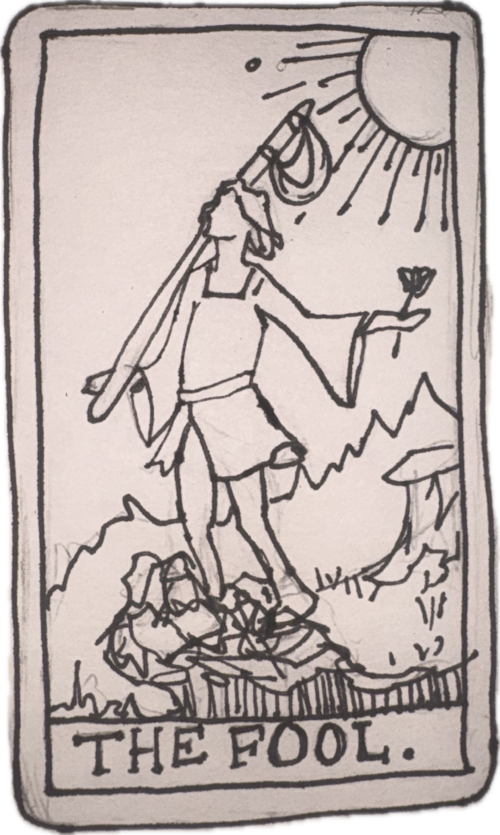
Maybe your quirky aunt tells you stories of destiny, or maybe you stumbled upon one of those “this video was meant to find you” reels with face-down cards on the thumbnail. But have you ever learned the art of predicting the future?
In a tarot deck, each card shows a scene with a figure at its center: a woman pets a lion, a knight rides his horse to the battlefield, and a family merrily watches the rainbow. This art form was once considered a relic, pulled out for amusement at cocktail parties or college reunions. However, tarot has become increasingly popular in the 21st century.
A Brief History of Tarot:
Like all good things, the story of tarot in Europe begins in 15th-century Italy. “Tarocchi” began as a card game for emperors and nobles. The suits of swords, cups, pentacles, and wands are the ancestors fo the spades, hearts, diamonds, and clubs in a moderning playing-card deck. The cards had values from one to ten, plus the face cards—king, queen, knight, knave—and a wild card: the fool.
Tarot was not used for divination until the 19th century. It gained popularity among occultists after 1861, with French author and occultist Éliphas Lévi’s book “The Doctrine of Transcendental Magic.” The illustrations for the Rider-Waite-Smith tarot deck, widely known today, were created in 1909. Arthur Waite translated Levi’s book into English in 1886, and Pamela Colman Smith drew the cards years later according to Waite’s instructions; both were members of “The Golden Dawn,” a ceremonial magic society. Her illustrations had an Art Nouveau style with organic forms like vines and flowers, and long, sinuous lines. Today, tarot decks come in many styles and themes. You can find cat-themed tarot cards or more cartoonish, modernized decks. These variations add flair to the classic deck and let people personalize their spreads in a fun way.
The Fool’s Journey:
The cards also tell a story of their own. The “Major Arcana,” the 22 core cards of the deck, trace “The Fool’s Journey.” Here is how it goes:
The Fool begins his journey with excitement in his heart. He aspires to become the Magician and create his dream reality. The High Priestess and her divine wisdom guide the start of this spiritual journey. His mother, the Empress, representing Mother Earth, offers him care and abundance. His father, the Emperor, sets rules and boundaries to keep him safe on his path.
The Fool begins practicing spirituality more formally with his mentor, the Hierophant. As he works on the task at hand, he craves a companion and seeks love. The Lovers represent connection, and the pair bring joy to each other. With that, the Fool rides the Chariot toward his goals. The Fool now finds the Strength to achieve his dreams.
At this point in his journey, the Fool withdraws to reflect, becoming the Hermit. He realizes fate, represented by the Wheel of Fortune, is inevitable. The wheel can turn one way or the other, bringing joy or destruction. Yet life offers each in balance, and divine Justice prevails.
The Fool is in his comfort zone. He feels safe to explore things from a different perspective as the Hanged Man. He looks at the world hanging upside down from a tree, surrendering to his fate without concern of falling. He encounters Death, symbolizing the demise of his past self. He learns patience, gaining Temperance. Then, the Devil persuades him to let go of the past. He faces a hard time and cannot help his situation. The Tower he built, reflecting his old values and beliefs, is struck by lightning and destroyed.
Somewhere amid the darkness, the Fool sees something bright—the Star—and finds hope. The Moon, contrary to the Star, reveals the uneasiness and gloom in his subconscious. Finally, the Sun shines. Folly is replaced by wisdom, and, through Judgment, he answers his calling without false identities. His journey is complete, culminateing in the World.
The Fool’s journey seems quite abstract. Yet, you can find him in a first-year student starting a new journey away from home or a recent alumnus trying to navigate life alone for the first time—along with the rest of the arcana.
What Does the Card Say:
The beauty of tarot is in the eye of the beholder. Each card has a traditional significance derived from the Fool’s journey, but that is only the beginning. The shapes, colors, symbols, and figures on each card can add to its meaning and vary across cultures. For instance, a reading in India could incorporate Vedic astrology. The reader’s perspective and the context of the pull also affect the interpretation.
Generally, swords represent thoughts, cups feelings, pentacles material matters, and wands actions. Swords correspond to air, cups to water, pentacles to earth, and wands to fire. Colors on the figures’ clothing or in the background also carry meaning. Red can represent anger or bravery, blue imagination, white peace, yellow calm or hope, green abundance, and so on. Birds are usually considered messengers; apples represent abundance; pillars represent strength; and thrones represent leadership and power.
The sky in the card can also give hints: a clear sky could mean a clear state of mind; rain, distress; and the sun, joy. If a card is drawn upright, it usually has a positive meaning, and the card’s message is clear. If the card is upside down, it signifies blocked or delayed energy.
Tarot cards are also often connected with other spiritual areas. For instance, each zodiac sign has a specific associated card. Each card has an astrological correspondence, an element, and a chakra link can represent either yes or no.
Whether you believe in divination or not, you cannot deny that tarot has stood the test of time. If you want to incorporate a little bit of tarot into your daily life, consider booking a reading or trying an online tarot reading through websites such as “Daily Tarot Draw.” Tarot spreads can be simply a daily push of motivation, a three-card spread for the full moon, a yes-or-no about your love life, or something for midterm season—whatever your heart desires.
Delfin Urundul ’30 (durundul@college.harvard.edu) was introduced to tarot by her roommates at 3 a.m. in her high school dorm.