It’ll Pass
Graphic by Janelle Souro

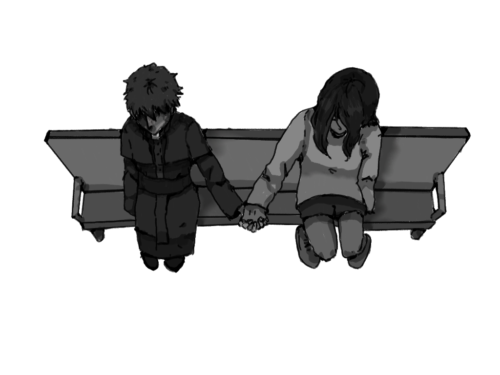
A priest and a worshiper, not of the Christian faith but of the priest himself, sit beside each other in silence at a nondescript bus shelter in the middle of the night. The worshiper has an interesting name: Fleabag—an odd thing to call a child. (I doubt it is her real name.) The silence is interrupted. She says, “You know, the worst thing is”—she pauses—“I fucking love you.” She pauses again, this time not for effect. Her sheepish smile disappears, and her glossy eyes meet his in an embrace of sorts. How eyes can embrace, I do not know, but in this moment they just do.
“I love you,” she says again, more sincere this time. She really means it. His mouth moves to speak, and those smile lines return, perhaps out of embarrassment. How could she be so naïve as to think her love would move a man of the cloth? “No, let’s leave that out there just for a second on its own,” she says. “I love you.” His hand takes hers, though this time not as a priest to a parishioner. Their fingers interlock, and between blinks he says, “It’ll pass.”
Crushing.
Their eyes dart toward each other and then, just as quickly, look away as if holding a stare would be too much to bear. A man wrestling with his faith. A woman wrestling with her heart. You could almost write a book about it or a multi-award-winning comedy-drama television series—either works.
They make some quick jokes. He gets up to leave but pauses and looks back. “I love you, too,” he says, as a single tear runs down his face. “Okay,” he adds, and turns to go. I imagine she had more to say—words to try to convince him to take off his collar, renounce his faith, and live her hopes and dreams—but she remains silent.
“It’ll pass.” Hard words to hear at any point in one’s life; I imagine, even more so after pouring out your heart at a dreary bus shelter in the middle of the night. “It’ll pass,” he said, and in doing so, he not only denied his love for her, but also her love for him. It takes an incredibly strong man—stronger than I could ever be—or an incredibly stupid one to walk away from his hopes and dreams on principle. Nevertheless, he walked.
***
Love is many things, though I, at 20, am not too well versed in its complexities. However, to me, love is difficult; it is painful, filled with concessions and compromises. It is exhausting, but it is rare and beautiful in its existence. I was reminded of love’s beauty while listening to Matt Fradd’s “Pints with Aquinas” podcast. That particular episode’s guest was Boston College professor Peter Kreeft, who spoke about love and the loss of his wife of 63 years, Maria Antoinette Kreeft. Kreeft said, “The last view I had of my wife, about an hour after she died, I fell in love with her again. Here is a wasted, emaciated, wrinkled, suffering body. It’s as beautiful as a crucifix. Because that body ain’t gonna last, but the soul is. So, if you don’t love her soul, but just love her body, then don’t get married.”
“As beautiful as a crucifix.” A love that surrenders all. But let us embody Fleabag’s suggestion: to “leave that out there just for a second on its own.” Kreeft’s words tugged at my heartstrings not only because he described his love for his wife so eloquently, but also because they reminded me of my own life.
I’ve never been able to find language like Kreeft’s to describe the love I have for other people or the love I see in the relationships around me, but I have seen the love he is talking about in action. In particular, in the relationship my father’s mother has with her husband, in spite of the fact that he passed away over a decade ago. For nearly thirteen years, she has loved a man who can no longer love her back, and still, her love has never diminished.
The Sacramento Valley National Cemetery is a serene place. Even the birds do not chirp their usual tunes, perhaps out of respect for the veterans buried beneath their ground or, more likely, because of the distinct lack of trees surrounding the cemetery. Regardless, my grandfather lies in Section Five. “A Patriot to God, Family, and Country,” his headstone reads; truer words could not be said of the man he was.
At 88, my grandmother’s hands are usually shakier than most people’s, but when we visit grandpa, they are completely calm. They reach up to her lips, then rest on his headstone. “I love you, Richard,” she says, her eyes welling up with tears—ours well with hers. It is like Kreeft said: “[the] body ain’t gonna last, but the soul is. So, if you don’t love her soul, but just love her body, then don’t get married.” I can tell you right now that you will be hard-pressed to find a woman who loves a man’s soul more than my grandmother does, and that is the beauty of love. Twelve years following his passing, it is as if she falls in love with him again every time she visits.
I imagine that she does not feel a cold headstone when her hands rest upon the granite. Instead, she feels her husband’s warm hand. The warm hand that guided her dancing around the Noncommissioned Officers Club before both their hands were full with two babies. The same hand she held as they watched their children get married, and the hand that held their grandchildren some 50-odd years after they first held her own.
It must be beautiful to be that in love. So, with that, I return to Fleabag. I initially posited that the priest was either incredibly strong or stupid to walk away from what he knew was real love. Thinking about it now, I can only surmise that he is incredibly stupid. A love like that will not pass and may only come once in a person’s lifetime.
Consternation will pass, doubt will pass; everything but love will pass and, in the grand scheme of things, whittle itself down into nothing. A life without love is a life left unsatisfied, and so, this is all to say: if you are offered love—true, genuine love—in your life, take it. It will be imperfect; it may suck for a while, but take it because it is “as beautiful as a crucifix,” and if it passes, it may never come back again. Choose love if you choose anything in this life, and you will be eternally grateful that you did—that much I do know.
Noah Basden ’29 (nhbasden@college.harvard.edu) writes Forum for the “Harvard Independent.”