Which Witch Is Which?
Graphic by Evelyn Ferguson

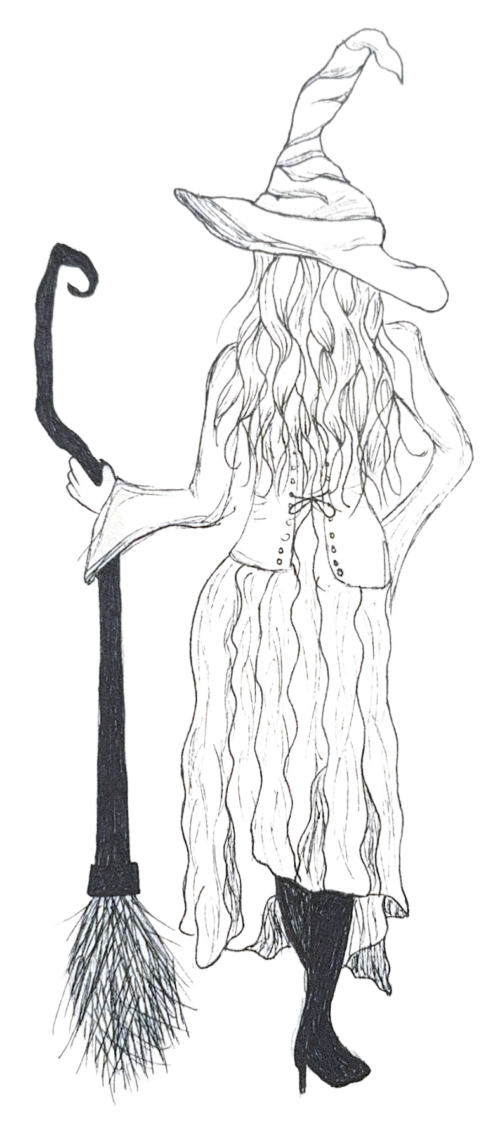
Tituba, one of the first people accused of witchcraft in Salem, Massachusetts, was not Black. Over the next three centuries, writers made her Black anyway.
Tituba, an enslaved woman living in the house of Reverend Samuel Parris, is described as “Indian” in the 1962 court records. She was an Indigenous woman, and Puritans shaped her testimony to fit the kind of witchcraft found in European folklore. In 1868, Henry Wadsworth Longfellow depicted her as “part” Black and invented a father who taught her Obeah, an African-Caribbean spiritual practice. In 1953, Arthur Miller’s “The Crucible” cast her as a Black woman from Barbados, leading Salem’s girls in Voodoo rituals in the woods.
No new evidence supported either change. The later retellings gave the story a Black face for “dark magic,” despite the historical record. That instinct never went away. It is why, in 2018, Sephora could package rose quartz and sage into a $42 “Starter Witch Kit,” while two years later Beyoncé was called satanic for singing about charging her crystals in the moonlight.
Neither the “Starter Witch Kit” nor Beyoncé is an isolated case. Crystals, sage, ancestor altars, and other borrowed folk healing practices are rebranded and sold as “self-care” and “wellness” when white people use them, but they are labeled “black magic” or evil when Black and brown people use them. Despite their origins in old traditions rooted in Indigenous healing practices from the Americas, Africa, and South Asia, the current state of wellness culture today centers on whitewashed versions. Traditional media built this standard, but social media has continued to amplify it.
Much of the rhetoric around “black magic” comes from misunderstanding, so it is worth being precise about the terminology.
Vodou, or Voodoo, is an organized religion with West African roots, including both Haitian Vodou and Louisiana Voodoo. It is widely misunderstood as “dark magic” practiced by Black women, an assumption that confused Voodoo with Hoodoo. Hoodo is a separate tradition: a set of African American folk magic and rootwork practices, not a religion. It focused on practical, earth-based magic, personal empowerment, healing, and ancestor veneration, with the aim of creating tangible change in everyday life. It is considered magic, but not evil.
Historical Roots: How “Witch” Became Racialized
The racialization of these folk practices did not happen overnight; there was a slow but consistent campaign to rewrite the history of witchcraft. Practices of witchcraft were initially outlawed in Europe during the Middle Ages because they were tied to survival, identity, and resistance—whether against Christianity, the monarchy, or both.
The associations between witchcraft and resistance led dominant Western narratives to tie Blackness and witchcraft to villainy, allowing them to weaponize racism and suppress spirituality. Tituba, recharacterized as Black in Arthur Miller’s fictional adaptation of the Salem Witch Trials despite being Indigenous, is a key example of the intentional archival rewriting of witchcraft history. American retellings of witchcraft needed a Black “source,” and they found one by casting Black women as the origin of evil, a framing that justified efforts to root out witchcraft.
The hatred of folk practices, branded as “evil” or “dark” magic, spread from Europe to European colonies, and beyond. Voodoo in Haiti was prohibited for 150 years when France’s 1685 Code Noir banned African religious practices and forced enslaved people of Haiti to get baptized. The ban on Voodoo is also a lesser-known contributor to the Haitian Revolution. The revolution began with the 1792 Bois Caïman Voodoo ceremony. Even after independence, Haiti outlawed many popular spiritual practices from 1835 to 1987 to counter the foreign portrayals of Haiti as “primitive.”
This illustrates the long-lasting effects of racist colonial powers even in the postcolonial era. Haiti was motivated to change cultural practices entirely because of the external false narratives surrounding Voodoo and a willful ignorance of the religion itself. Countless rumors shaped society’s view of the religion, as well as government policy in Haiti. The infamous 1864 Bizoton trial, which alleged a “Voudou child sacrifice,” caused negative perceptions of the religion for over a century. Discourse surrounding the trial resulted in a crackdown that fueled the Catholic anti-superstition campaigns. These campaigns formed around the common goal of eradicating Voodoo—temples and sacred objects were destroyed, and priests suspected of the practice were forced to convert or face prison.
In the United States, similar attempts to destroy Native cultural practices were occurring. The 1883 Code of Indian Offense outlawed Native ceremonies, dances, and healing practices. Anyone suspected of violating the code faced arrest, fines, or vigilante justice. The U.S. government did not stop at codifying vague laws; it intentionally targeted healing and resistance practices. Rituals like the Sun Dance, purification rites, and medicine people were prohibited.
All of these historical examples point to a specific conclusion: Black and brown practices of survival and resistance were targeted to suppress resistance to racism, colonialism, and oppressive governance.
Witches and Race in Film, TV, and Books
Historical rhetoric set up the racialization of witches in film, television, and books in the 20th and 21st centuries. When examining the examples below, a pattern emerges: white witchcraft is coded as empowerment and sisterhood; Black and Caribbean magic is coded as horrific, villainous, or in service to a white lead.
Some of the oldest films point to this truth. “White Zombie” (1932), the first real film about the “undead,” came out while the United States was occupying Haiti. Its promotion sensationalized the “savagery” of Black Haitians under the control of a “voodoo master” played by a white Hungarian actor. Scholars read the film as presenting Vodou as a threat to white Christian Americans.
These representations also reached children’s media, such as Disney’s “The Princess and the Frog” (2009). Unlike “White Zombie,” this work cannot be read as a product of its time. The Princess and the Frog gave us the first Black princess, but it also gave us the first Black Disney villain. Dr. Facilier, a “voodoo witch doctor” (yes, that is what he is called), dominated the screen as a caricatured portrayal of Black spirituality. Facilier is also referred to as the “Shadow Man,” further entrenching the association between Black cultural practices and evil. Religious studies critics have focused on how Disney’s portrayal of Facilier has distorted an understanding of Haitian Vodou. Others add that Disney packs the religion’s stereotypical image into one character.
Some might argue that Mama Odie, a priestess and mentor in the movie, is a “good” Voudou practitioner; this could not be further from the truth. Although her “magic” is used for good, the film portrays her in a strongly caricatured way: a head wrap and “magic voodoo powers.” The portrayal of her as a “good practitioner” still entrenches stereotypes of Voudou, resulting in a racist representation that arbitrarily paints certain practitioners as morally neutral or good according to the opinions of the screenwriters, whereas others are illustrated as malevolent.
Representations of Black witches in media that do not portray them as evil practitioners of Voudou often illustrate them as sidekicks or sacrifices. For example, in “The Craft” (1996), the character of Rochelle was rewritten as Black after Rachel True was cast; her character’s main conflict involved experiencing racist bullying. Even beyond this stereotype, critics note that she received far less backstory than any other character with a comparable amount of screen time.
While Black witches and Voodoo practitioners are often portrayed as the villain or the sacrifice, it is important to place them in contrast to their white counterparts. Numerous shows portray the white witch as the heroine: “Practical Magic,” “Charmed,” “Hocus Pocus,” “Sabrina”—their magic is presented as quirky, cozy, and empowering, juxtaposed against a darker evil force.
#WitchTok: Are Your Chakras Aligned?
The consistent association of Black and brown spirituality with villainy and deceit throughout history and across books, shows, and films has similarly found its way to social media. Across Instagram and TikTok, “#WitchTok” has emerged as a subculture where creators share modern witchcraft, manifestation, and spiritual practices. In fact, #WitchTok had around 33 billion in October 2022. The most popular videos include crystals, tarot, manifesting, and moon rituals. These videos have something in common: popular creators are often white, but they draw content from the previously disavowed aspects of Black and brown culture.
Cultural blending is not inherently bad; the internet has made the world more globalized, and it is often interesting and impactful to learn about and respectfully participate in the practices of those different from you. The key word, though, is respectfully. Often, TikTok witches don’t engage with the history and authenticity of the practices they end up appropriating. Creators will often mix aspects of distinct cultures, treating Hellenist, Hindu, and West African gods and cultural practices as interchangeable.
White creators end up overwriting the history of these practices all while profiting from them. Hoodoo was created by enslaved Black people in the United States, so why are most TikToks about Hoodoo honey jars coming from young white women? Black creator @thathoneywitch points this out. Yoga is an ancient spiritual practice, so why are you joking about “aligning your chakras” through drinks and dinner? This appropriation often detaches viewers from the connections these practices have to marginalized cultures, which leads to spirituality being treated like a joke or a trend. The history and tradition behind many of these practices simply cannot be imparted in a two-minute video.
The monetization of spiritual practice on social media is also problematic. You can buy crystal bundles on TikTok Shop, and white creators will recommend idols and effigies to purchase, all while capitalizing on a practice that is not theirs. Retail data shows crystals are the most-searched “witchy” product category, often bought as home decor. Ultimately, social media is not just a hobby—it is a job, and it is disturbing that white creators can benefit from the labor of Black and brown people especially since the labor of those communities has gone unrecognized.
Witchiness is deeply intertwined with the politics of race and ethnicity. We are all a part of it: when we participate in “spiritual” trends, when we code certain actors and characters as “villainous,” when we pull from different cultures to create costumes, like the voodoo priestess outfits that hit store shelves every Halloween. Each time, we are deciding whose magic is sacred, whose is spooky, and whose is just for sale.
Anika Gupta ’30 (anikagupta@college.harvard.edu) and Salma Gheith ’30 (salmagheith@college.harvard.edu) are coming the “Harvard Independent.”